
The vegetable garden notebook / Crops
Growing elephant garlic: planting, care and harvesting
Elephant garlic produces large cloves with a mild flavour. To obtain bulbs, it requires a long growing season and soil that drains well, particularly during winter. An intact bulb can also be used for the next planting.
Adapt this guidance to your garden’s climate and conditions.
Choosing Elephant Garlic for Its Large Cloves
Elephant garlic is Allium ampeloprasum, a close relative of leeks. Common garlic is Allium sativum: white, pink and purple garlic are therefore groups of common garlic, not varieties of elephant garlic. The RHS describes a large bulb with a small number of very large, mild-flavoured cloves.
Select planting material identified by its botanical name. Ask the supplier about its origin and the instructions for your area. For the method described here, ask for cloves ready for planting. A whole, single-clove or “solo” bulb is another way to start; replant it according to the instructions supplied with it. Small peripheral offsets are used for propagation: do not purchase them expecting the same result as with a large clove by the next harvest. The RHS describes their separation after flowering, without specifying how long they take to produce an edible bulb in France.
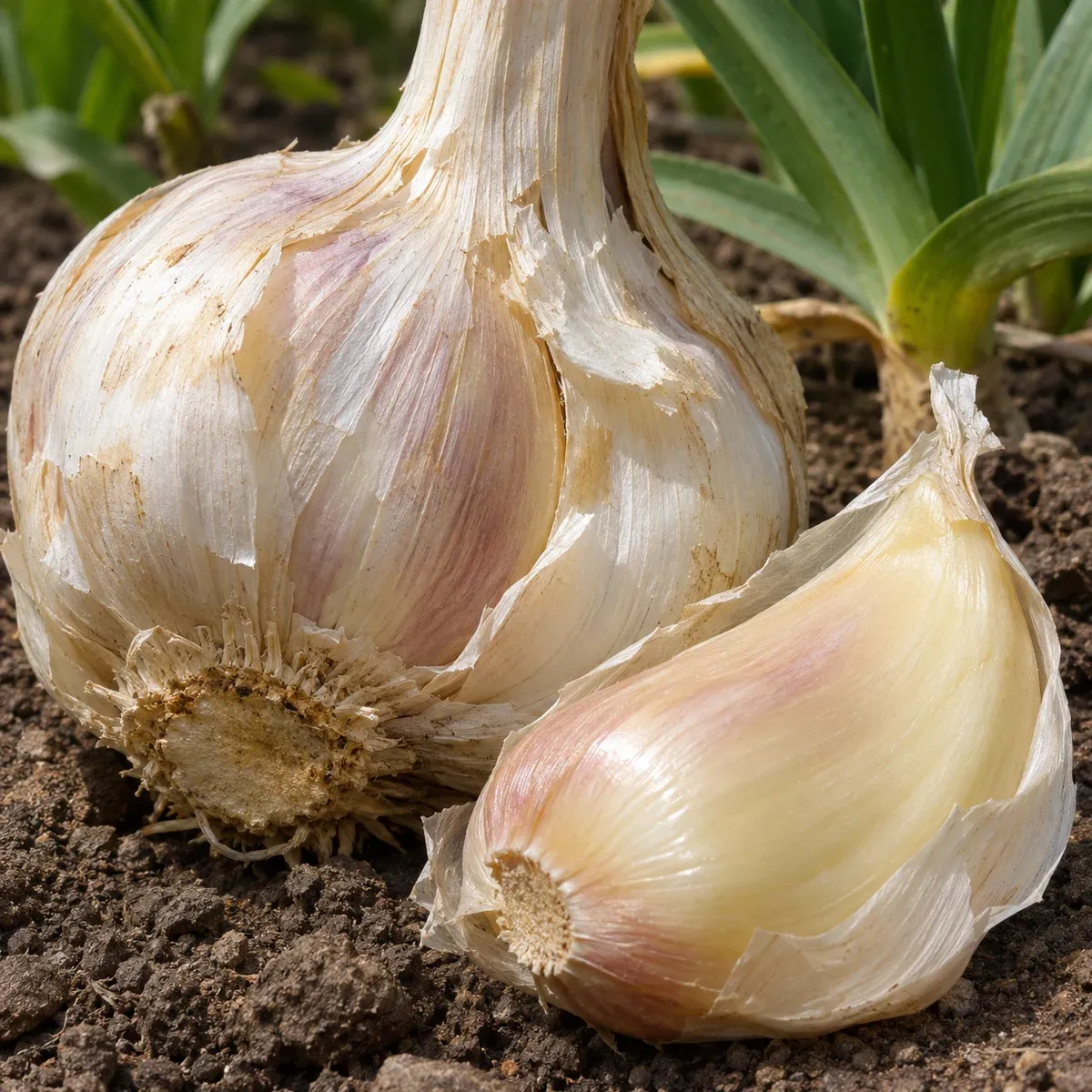
Planting Cloves in Sunny, Well-Draining Soil
The RHS emphasises the need for a long warm growing season and favours autumn planting in the UK. In France, choose the period with the supplier according to your climate and soil condition; a fixed date is no help if the soil is frozen or waterlogged. Late planting increases the risk of harvesting a solo bulb.
Select a sunny, fertile, and well-draining location. The plant profile even recommends pots when the garden’s clay soil remains waterlogged in winter.
- Prepare loose soil, free of competing weeds.
- Separate the cloves at planting time, then place them with the tip facing upwards. UF/IFAS
- Space the cloves approximately 15 to 20 cm apart, a guideline consistent with Wisconsin and UF/IFAS. Before planting, ask the supplier how much soil to put over the cloves, taking account of your planting material and soil: explicitly ask how much soil should cover the tip, rather than a “depth” without a reference point.
- Maintain access to observe and weed without damaging the bulbs.
UF/IFAS specifies how much soil should lie above the clove, but its guidance is for Florida; it does not become a general instruction for France. If the batch’s instructions remain ambiguous, clarify them before planting. Do not add together planting depth, soil cover and earthing up.
In Pots and During Winter: Prioritise Water Drainage
Elephant garlic can be cultivated in pots. Choose a container with drainage holes and enough room for the cloves to be spaced out and develop; ask the supplier what depth it needs. A small starter pot is not a suitable container for the entire growing season.
The RHS describes the plant as hardy. The Wisconsin guide recommends mulching autumn plantings. Adjust winter protection to your local conditions while maintaining drainage: a protective layer does not correct waterlogged soil.
Supporting Growth and Monitoring Maturation
During growth, check soil moisture and water during dry periods: UF/IFAS recommends consistent moisture for elephant garlic. Use the watering guide to adjust watering to rainfall and the container, rather than applying the same number of litres in every garden.
When the foliage yellows, do not automatically continue the same watering programme: check the bulb’s condition and the drainage. If plants yellow and decline early, also check for pest or disease problems; yellowing does not prove that the bulbs are mature.
For feeding, start with the fertile soil recommended by the RHS.
Flowers, Solo Bulbs, and Propagation
A flower stalk topped with a ball of flowers may develop. If you are growing for bulbs, remove the stalk while still young: this is the specific advice for elephant garlic from UF/IFAS and the Wisconsin guide. If you are growing the plant for decoration, letting it flower serves a different purpose; do not compare the harvests as though the plants had been grown in the same way.
A solo bulb, without separate cloves, is not in itself a disease. The RHS indicates that it can be consumed or replanted the following autumn; it will then usually produce a bulb divided into cloves.
Use the cloves to grow the next crop. The RHS profile also mentions the separation of offsets after flowering.
Monitoring Leaves, Base, and Allium History
The RHS cites slugs, snails, and the allium leaf miner, as well as white rot and onion downy mildew, among the possible problems. This list cannot tell you what caused a leaf to turn yellow.
Look for animals, chewed areas or leaf mines, and check the base of the plant; photograph the whole plant and affected parts if you seek advice. Do not use a suspect bulb to propagate the crop.
On the rotation plan, record elephant garlic alongside the other alliums you have grown. A change from common garlic to elephant garlic is not enough to eliminate their shared health risks. If you suspect rot, have the cause identified before deciding when to grow alliums in the same spot again.
Harvesting, Drying, and Sorting Before Storage
The leaves fade and then yellow as the bulbs mature, as described by UF/IFAS. Check one bulb before lifting the entire row. Loosen the soil around the bulbs with a fork, then lift them without tugging hard on the foliage.
Dry the bulbs in a single layer in a dry and airy place. Then store the healthy bulbs in a cool, dry, and dark place; inspect them regularly and separate those that soften or deteriorate. The storage duration published for Florida is not a promise for your harvest: drying, damage and conditions in the storage space affect the result. Keep healthy planting material for the next crop separate from the rest.
Key points for this crop
Practical guidance
- Identity
- Allium ampeloprasum, closely related to leeks
- Location
- Sunny, fertile, and well-draining soil
- Planting
- Cloves about 15 to 20 cm apart; follow the supplier’s instructions for your lot
- Harvest
- Monitor yellowing and inspect one bulb
Sources and references
- How to grow garlic — Elephant garlic sectionRoyal Horticultural Society, in English Accessed on 18 October 2026.
- Allium ampeloprasum 'Elephant'Royal Horticultural Society, in English Accessed on 18 October 2026.
- Growing onions, garlic, leeks, and other alliums in Wisconsin — A3785University of Wisconsin Extension, K. A. Delahaut and A. C. Newenhouse, in English Accessed on 18 October 2026.
- The Joys of Growing Elephant GarlicUniversity of Florida IFAS Extension, Molly Jameson, updated 29 March 2023, in English Accessed on 18 October 2026.