
The vegetable garden notebook / Crops
Growing chamomile: annual German chamomile or perennial Roman chamomile
Two chamomiles require different approaches: German chamomile is renewed from seed each year, while Roman chamomile retains a perennial rootstock. To harvest flowers, start with a clearly labelled species and horticultural form.
Adapt this guidance to your garden’s climate and conditions.
Choosing the species and a flowering form
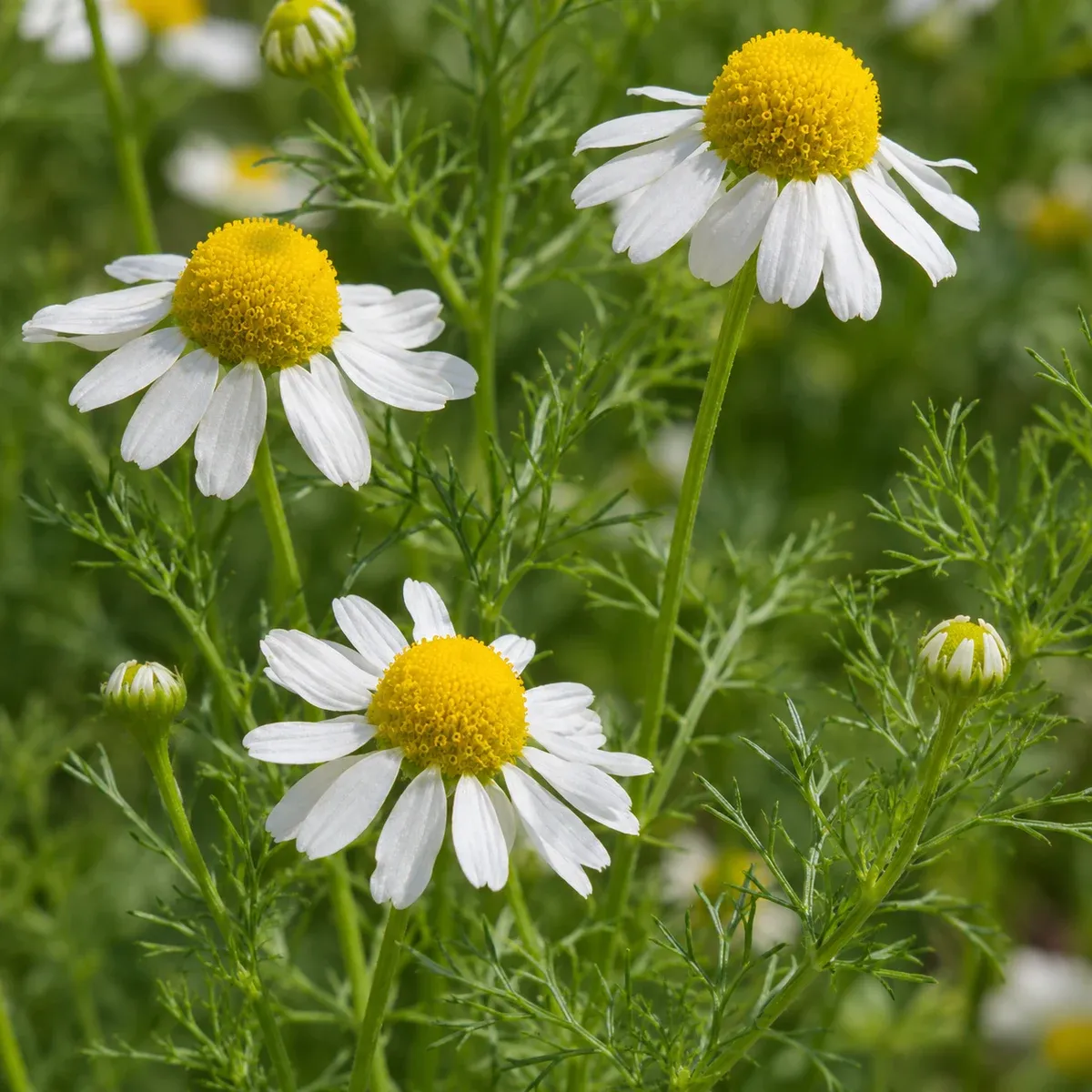
Start with seeds or plants labelled with a botanical name. German chamomile, Matricaria chamomilla, also called M. recutita, is an annual with upright stems. Roman chamomile, Chamaemelum nobile, synonym Anthemis nobilis, is perennial and spreads through its creeping growth. This distinction helps in selecting the cultivation method; it is not a guide for foraging “chamomile” in the wild. NC State, German chamomile, NC State, Roman chamomile
For a harvest of flower heads, exclude the Roman chamomile ‘Treneague’, a ground-cover selection that does not flower. A double-flowered form like ‘Flore Pleno’ does not produce viable seeds according to the RHS: it is propagated by division. Therefore, check the label before expecting flowers or collecting seeds. RHS
Sowing German chamomile on the surface
In France, Sainte Marthe recommends sowing in pots from March to May, or directly in the ground from April to June. Adjust the timing to when your soil has warmed up and you can keep the surface moist. Spread the seeds on the surface without burying them. The producer indicates 12–20 °C and 10–20 days for seedlings to emerge; the grower does not require cold treatment. Sainte Marthe, German chamomile
Thin to 25 cm apart following the same method. For sowing in pots, keep the young root balls intact when handling them: NC State notes that German chamomile does not tolerate transplanting well. Harden off plants grown under cover before planting them outdoors. Sainte Marthe, German chamomile, NC State, German chamomile
Starting Roman chamomile from seed or young plants
Sainte Marthe suggests sowing Roman chamomile under cover in March–April, or directly in the ground in May, on the surface of a fine mix of potting compost and sand. At 20 °C, the grower’s guide gives 20–30 days for seedlings to emerge: they may not emerge as quickly as German chamomile. Sainte Marthe, Roman chamomile
A labelled plant or division avoids this step. Plant in well-drained soil, in full sun, and water at establishment. For a group of plants intended for flowers, the RHS recommends approximately 15 cm between plants; then allow space for the mat to spread. This guideline differs from the thinning distance for German chamomile above. Sainte Marthe, Roman chamomile, RHS
Allowing space in the garden or pot
German chamomile has an upright habit that can reach approximately 60 cm according to NC State. Ensure access to the stems for repeated harvesting. This source advises against heavy, very rich, or constantly wet soils: prioritise drainage above all. NC State, German chamomile
Roman chamomile forms a mat; Sainte Marthe describes 10–30 cm in height for the form it offers. In containers, choose a low-growing, flowering form and a pot with drainage holes, filled with free-draining potting compost. Monitor moisture more frequently than in open ground. Sainte Marthe, Roman chamomile, RHS
Watering and pruning according to the objective
Water during establishment, then check surface moisture: German chamomile roots are shallow. Water without saturating. Wisconsin indicates it grows in poor soil with little fertiliser. For Roman chamomile, routine feeding is not needed according to the RHS. Wisconsin, RHS
Roman chamomile that becomes sparse can be trimmed during growth to encourage denser foliage. Keep flowering stems if you aim to harvest flowers. RHS, Roman chamomile
If seedlings fail to emerge, first check for seed burial and surface drying. If an established plant is declining, inspect its base and root ball: standing water can cause rot, particularly in winter. Also observe young shoots for slugs, snails, and aphids; yellowing alone does not identify them. RHS
Harvesting and drying cultivated flowers
Pick flower heads as they begin to open, regularly throughout the flowering period. The RHS provides this guideline for both species. For German chamomile, Sainte Marthe describes harvesting every two to three days: adjust this based on the flowers actually available, without waiting for a fixed date. RHS, Sainte Marthe, German chamomile
Spread the flowers in a single layer in a dry place, out of direct sunlight. Store them completely dry, protected from light and moisture, with the species and date noted. For good aroma, aim to use them within a year. RHS, Sainte Marthe, German chamomile
Renewing the annual and maintaining the perennial
German chamomile is annual: save seeds or allow some flower heads to self-seed if you want replacement plants. A new seedling does not mean that the same plant has survived. Keep Roman chamomile as a perennial; divide its rooted sections to propagate or limit its spread. Wisconsin, RHS, Roman chamomile, NC State, Roman chamomile
Maintain drainage during winter. Choose its location in the vegetable garden based on access, light, and water. Consult the companion planting guide to plan which plants to grow alongside it.
Key points for this crop
Practical guidance
- German chamomile
- Matricaria chamomilla, synonym M. recutita: annual
- Roman chamomile
- Chamaemelum nobile, synonym Anthemis nobilis: perennial
- Sowing
- On the surface, with light and regular moisture
- For flowers
- Exclude ‘Treneague’, a Roman chamomile form without flowers
Sources and references
- How to grow chamomileRoyal Horticultural Society, in English Accessed on 18 October 2026.
- Successful cultivation of German chamomileLa Ferme de Sainte Marthe, seed supplier Accessed on 18 October 2026.
- Roman chamomile AB — Anthemis nobilisLa Ferme de Sainte Marthe, seed supplier Accessed on 18 October 2026.
- Matricaria chamomillaNC State Extension, in English Accessed on 18 October 2026.
- Chamaemelum nobileNC State Extension, in English Accessed on 18 October 2026.
- German Chamomile, Matricaria chamomillaSusan Mahr, University of Wisconsin-Madison Extension, revised May 2026, in English Accessed on 18 October 2026.
- Chamaemelum nobileRoyal Horticultural Society, in English Accessed on 18 October 2026.