
The vegetable garden notebook / Techniques
Rainwater for the Vegetable Garden: Collection, Storage and Watering
A rainwater reserve can supply water to the vegetable garden, provided the source is chosen carefully and the system is maintained. The filter traps debris but does not make the water potable.
Adapt this guidance to your garden’s climate and conditions.
Practical steps
- Check the Collection Surface
Identify the roofing material and accessibility before connecting the gutter.
- Protect the Reserve
Provide filtration, an opaque and covered tank, secure access, and protection against insects.
- Maintain the System
Check the gutters, filter and cover, look for leaks and odours, and keep a record of maintenance.
- Water Appropriately
Consult local restrictions and check the soil before drawing from the reserve.
Which Water Can Be Collected for the Vegetable Garden?
For a domestic vegetable garden in France, the rainwater covered by regulations is collected downstream of surfaces inaccessible to people except for maintenance, specifically roofs other than those made of asbestos or lead. Identify the roofing material before connecting the gutter. If you are unsure of its composition, have it checked before using this collection method. Order, Article 4
This water may contain pollutants from the air or roofing. Clear appearance does not guarantee its quality. Watering the vegetable garden is among the permitted uses, but the collected water must not be used for drinking, cooking, or washing food. Use potable water to prepare harvested produce. Service Public, Order, Annex I
This guide concerns rainwater collection for outdoor use. Do not add shower, dishwashing, or laundry water to it: their reuse falls under a different framework. Permission to water with rainwater does not apply to all domestic water.
Set Up a Covered Tank and a Separate System
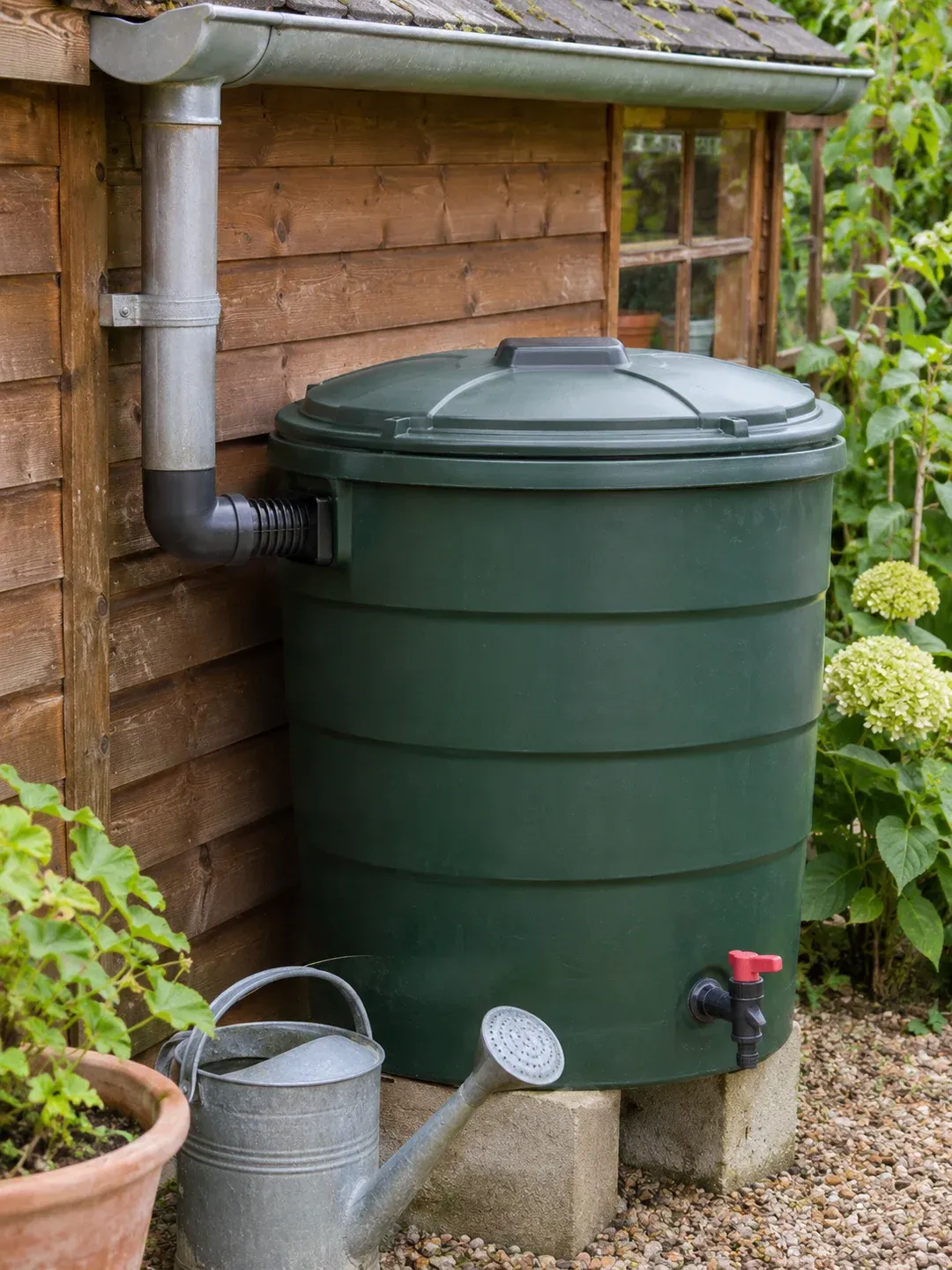
Choose a tank designed for this purpose, opaque, covered, and with secure access to prevent drowning. Materials must not leach contaminants. French regulations specify a filter with a mesh size of 1 mm or less before storage, vents fitted with mosquito-proof mesh of the same maximum size, and an overflow protected against insects and small animals. The filter limits sediment but does not disinfect the water. Order, Article 3
Install the tank on a firm, level base suitable for the equipment. Keep the tap and maintenance points accessible. The RHS also recommends a debris filter and a well-fitted cover. Plan for overflow drainage without uncontrolled runoff. Follow the manufacturer’s instructions for stability and connections; a full tank is a significant load to consider.
The system must remain entirely separate from the potable water network. Do not connect the two systems directly with a hose. Any connected top-up supply requires separation by an unrestricted air gap that meets the regulations; ask a professional to specify the arrangement. A check valve alone does not replace this separation. Order, Articles 2–3
Maintain the Tank and Address Odours
Clear leaves from gutters, check the filter, cover and insect protection, and look for leaks. Plan for draining and cleaning according to the manufacturer’s instructions and the system’s condition; keep a record of maintenance. The frequency should be adapted to the system: the monthly and annual minimums in Article 8 for greywater do not serve as a universal schedule for all rainwater tanks. Order
An unusual odour calls for inspection, not the improvised addition of a product. The RHS advises emptying and cleaning a foul-smelling tank and discourages using stored water for seedlings sensitive to disease. For these, prefer potable water. The absence of odour does not guarantee the absence of contamination. RHS, Service Public
Do not add antifreeze to the water. Before cold weather, follow the winterisation instructions specific to the tank, tap, and pipes. Order, Article 3
Water at Soil Level and Check Current Restrictions
First, check the soil in the root zone, as explained in the watering guide. Apply water to the soil without misting or spraying it on people or vegetables. Article 10 strictly regulates aerosolisation devices; the spray settings suggested by a British source do not apply here. Order
Before watering during dry periods, consult VigiEau for your address and the applicable prefectural order. Verify the permitted uses, times, water sources, and any exceptions explicitly mentioned: a reserve does not automatically grant exemption. If in doubt about the text, contact the prefecture or town hall. Ministry
Estimate Collection and Monitor the Reserve
One millimetre of rain represents one litre per square metre, notes Météo-France. The maximum geometric volume collected is therefore collection area in m² × rainfall in mm = litres. For a sloped roof, use its horizontal footprint served by the connected gutters, rather than counting the entire roof without distinguishing slopes.
Purely arithmetic example: 20 m² connected and 10 mm of rain represent 200 litres before losses. This does not mean 200 litres in the tank: some may be lost to wetting, uncaptured runoff, or overflow. If the tank only has 80 litres of free space, it cannot accommodate more than 80 additional litres. Do not assume a fixed recovery rate to adjust this maximum; compare it to observed levels in your system.
Next, calculate how long the stored water will last without rain: with a usable reserve of 120 litres and measured withdrawals of 15 litres per day, division yields eight days at the observed rate. Adjust this calculation to your needs, potential leaks, and the volume actually available for use.
To choose the capacity, base your decision on the areas to be watered, the actual amounts of water applied, and the available space. A tank will empty if demand exceeds collected rainfall. If it supplies a drip irrigation system, check the pressure and filtration requirements specified by the equipment with the adjustment guide.
Sources and references
- Order of 12 July 2024 on the sanitary conditions for the use of water unfit for human consumptionLégifrance, consolidated version in force as of 18 October 2026 Accessed on 18 October 2026.
- Rainwater harvestingService Public, Direction de l’information légale et administrative Accessed on 18 October 2026.
- Collecting, storing and reusing waterRoyal Horticultural Society (RHS), in English Accessed on 18 October 2026.
- Everything You Need to Know About DroughtMinistère de la Transition écologique Accessed on 18 October 2026.
- The Climate in Mainland France and CorsicaMétéo-France Accessed on 8 November 2026.