
The vegetable garden notebook / Techniques
Automatic Watering in the Vegetable Garden: Testing and Adjusting Drip Irrigation
A timer controls when watering starts and how long it lasts. To adapt it to your vegetable garden, first test how the water is distributed, then check which areas the water actually moistens.
Adapt this guidance to your garden’s climate and conditions.
Practical steps
- Group
Create zones combining crops with similar watering needs.
- Measure
Check the actual flow rate of several emitters in the circuit while it is operating.
- Adjust
Relate duration to volume, then verify the moisture achieved in the root zone.
- Monitor
Review the programme as the weather changes and check the filter, connections and emitters.
Start by grouping plants with similar needs
On a simple plan, mark out the beds, pots, shade, and slopes. A zone is a group that you water with the same programme. Group plants with similar needs, as advised by Iowa State University. A pot and an in-ground bed should not share a schedule simply because they are neighbours.
Also consider the stage of the crops. To decide if watering is necessary, refer to the general watering guide. The timer replicates your decision: it does not determine the need on its own.
If the water supply cannot properly operate the entire network, divide it into zones watered in succession. The available capacity and pressure limit the area that can be watered simultaneously. University of Georgia
Prepare a circuit compatible with your supply
Note the equipment requirements: operating pressure, filtration, flow rate, and maximum line length. The filter must suit the circuit’s flow rate; the pressure regulator must match the emitters. Even pressure-compensating emitters must operate within the range specified by their manufacturer. Utah State University
Follow the instructions for connection and maintenance. If the installation requires plumbing modifications or a fixed electrical connection, have a qualified professional specify how it should be connected.
Position the outlets to moisten the area where the roots are located. Their spacing depends in particular on the soil: water spreads differently in sandy soil and in clay soil. A visible wet spot is therefore not enough to verify coverage of an entire bed. Iowa State University
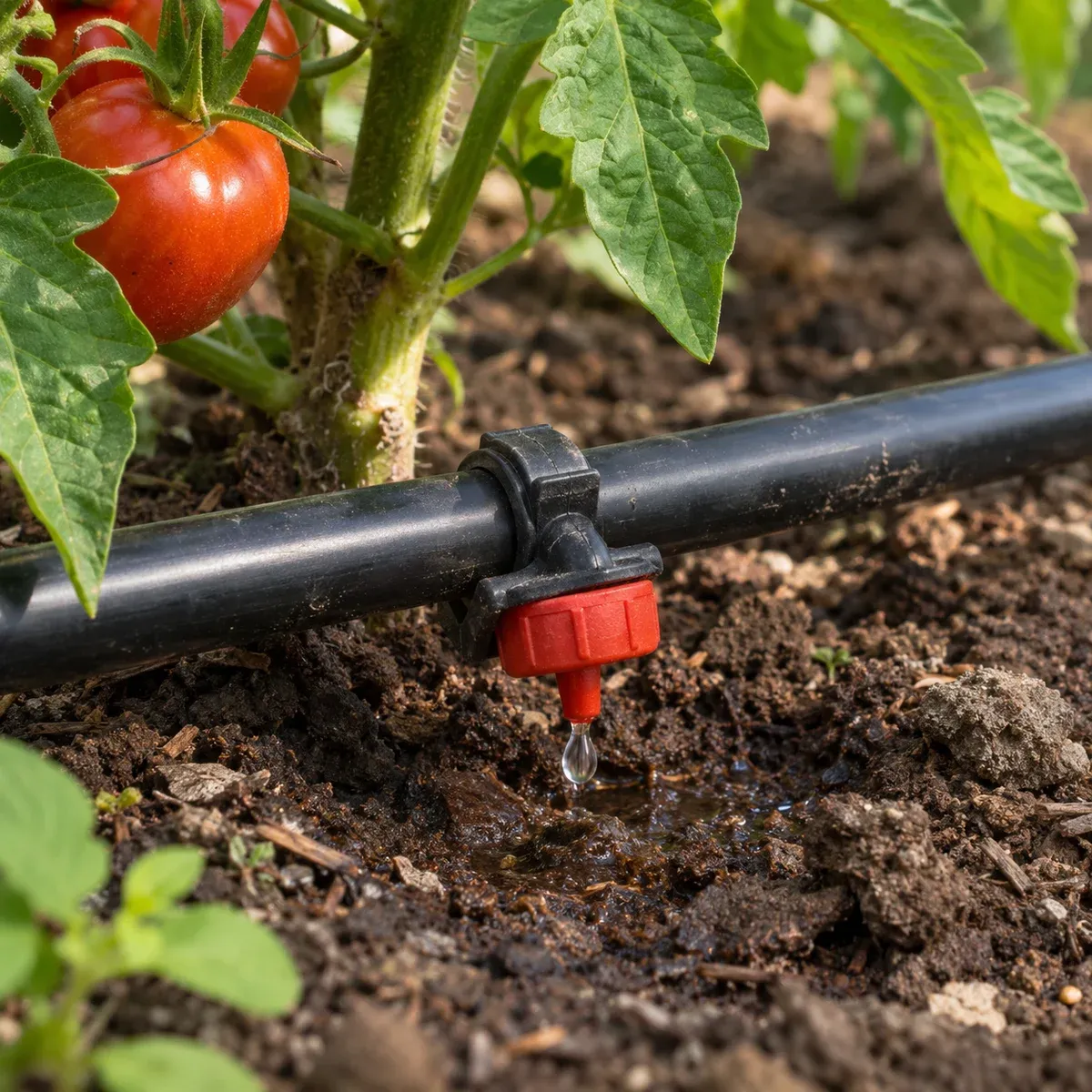
Measure the actual flow rate delivered
Operate the zone in its usual configuration. For accessible emitters, collect water from several outlets in separate containers over a known duration. Measuring an emitter’s output over a set time is a way to check it, as described by NC State Extension.
Choose points distributed across the circuit, particularly near the inlet and towards the ends. Compare emitters that are supposed to have the same flow rate. If some deliver much less water, investigate the cause before extending the programme for the entire zone.
The calculation in common units is: flow rate in litres per hour = volume collected in litres × 60 ÷ collection duration in minutes.
This is a calculation example, not a recommended watering amount: 0.5 litres collected in 15 minutes corresponds to 2 litres per hour. Keep the measurements and the circuit configuration to compare with a later check.
How long should the programme run?
There is no duration valid for all vegetable gardens. Colorado State University Extension recommends determining the runtime by examining soil moisture; equipment, pressure, and emitter layout affect the result.
If you have already established a suitable volume for the zone in question, the conversion is: duration in minutes = desired volume in litres × 60 ÷ total measured flow rate in litres per hour. Only add the flow rates of the emitters that supply this zone. This formula converts a volume into a duration; it does not calculate the vegetables’ water needs.
This conversion assumes that the flow rate remains comparable to the measured value, with the same configuration and comparable pressure. If these conditions change, re-measure before resuming adjustments. Utah State University notes that pressure can vary by time of day and that equipment must operate within the range specified by its manufacturer.
Supervise the first watering, then examine the soil in the root zone at several locations. Under mulch, move the cover aside to access the soil. If distribution is insufficient, re-examine the position of the lines; if the soil remains too wet, review the programme. Avoid correcting all problems by extending the duration. Colorado State University Extension
Adjust the programme for rain and growth
A simple timer does not automatically suspend its programme when it rains. A sensor can help, but its measurement must represent the zone to be watered. In an RHS trial on hanging petunias, a sensor reached by water too quickly stopped the application before the entire container was watered. The volumes used in this trial are not recommended watering amounts for vegetables.
After rain or a change in conditions, check the soil and reassess the next start time. Also adjust the programme as the plants grow. Automation still requires checks, even with a sensor. RHS
Checks to keep making, especially before you go away
Regularly check the filter, connections, and emitters. A filter clogged with sediment can reduce downstream supply; damaged pipes or blocked outlets need to be repaired or cleared. University of Georgia
Before you go away, watch a full cycle: check that watering starts, water flows in each zone, there are no leaks and the system stops properly. Then check the resulting soil moisture. Arrange for someone to inspect the garden and suspend watering if there is a problem.
Before leaving a programme running, consult VigiEau and the order applicable to your location and use. Restrictions are local and may change, as noted by the ministry. Do not assume that automatic drip irrigation is exempt.
Is a smart device necessary for your vegetable garden?
No: an internet connection is not a requirement for watering. Iowa State University describes drip irrigation controlled manually or by a timer. Choose equipment for a specific task: opening at a set time, distributing water, or measuring moisture. These roles are different.
A sensor complements observation; it does not measure the entire plot from a single point. The RHS case presented earlier shows why its position and the verification of water actually received matter. For a first vegetable garden, start by observing and testing the circuit before adding automation.
Sources and references
- Using Drip Irrigation in the GardenIowa State University Extension and Outreach, in English Accessed on 16 October 2026.
- The Do-It-Yourself Guide to Backyard Drip IrrigationUtah State University Extension, in English Accessed on 16 October 2026.
- Critical Management Issues for SDI Systems in North CarolinaNC State Extension, in English Accessed on 16 October 2026.
- Irrigating the Vegetable GardenColorado State University Extension, in English Accessed on 16 October 2026.
- RHS research shows the best way to water hanging basketsRoyal Horticultural Society (RHS), in English Accessed on 16 October 2026.
- Drip Irrigation in the Home Vegetable GardenUniversity of Georgia Cooperative Extension, in English Accessed on 16 October 2026.
- Understanding droughtMinistère de la Transition écologique Accessed on 16 October 2026.