
The vegetable garden notebook / Techniques
Urban vegetable garden: assessing the site before cultivation
To establish a vegetable garden on an urban site with little known history, begin by investigating its past and intended use. Lush vegetation or a pH reading alone are not sufficient to confirm that food cultivation is suitable.
Adapt this guidance to your garden’s climate and conditions.
Practical steps
- Document
Gather information on past uses, soil brought onto the site and any available records.
- Describe the project
Specify the crops, individuals present and intended consumption.
- Have the site assessed
Define investigations and analyses with expert guidance.
- Decide and monitor
Choose a compatible use and retain conclusions along with monitoring measures.
Does a fertility analysis answer the question?
pH, texture or organic matter describe agronomic properties. REFUGE distinguishes these analyses from those for pollutants. A soil favourable for growth does not, on its own, prove suitability for producing food. REFUGE
The approach outlined here prepares an assessment of the site; it cannot establish remotely that the site is safe. REFUGE is a 2019 guide designed for market gardening in open ground in Île-de-France; its advice must be kept within that geographic and technical scope.
Reconstructing the site’s history
Gather documents from the owner, old photographs, municipal archives and corroborated accounts. Note past and neighbouring activities, waste deposits and fill materials. REFUGE begins with this study before defining investigations. REFUGE
On Géorisques, consult information by address and detailed records: CASIAS lists past activities that could have caused contamination, without confirming soil contamination. Records may refer to original archives or the DREAL. Géorisques
The absence of an entry on a map does not establish that the site is safe: inventories may be incomplete and some sites may be inaccurately mapped. Record any gaps in the information as well. Géorisques, expert dossier
Describing the vegetable garden you wish to create
Prepare a brief summary: cultivated areas, open ground or containers, water source, individuals using the site and crops intended for consumption. Indicate the presence of children. Risk depends on pollutants, but also on exposure pathways, duration and affected populations. Géorisques, expert dossier
An assessment conducted for another use does not automatically apply to this project. In France, contaminated land is managed according to compatibility with the intended use. Géorisques, expert dossier
Who can arrange appropriate testing?
Contact the owner or manager and the local council to obtain available studies and local guidance. If in doubt, prepare the assessment with a specialist in contaminated sites and soils, in collaboration with a laboratory. Géorisques · REFUGE
Specify the zones, depths, substances tested and planned interpretation before sampling. A single random sample does not necessarily describe a heterogeneous site. REFUGE adapts this strategy to the history, soils and project; some suspected types of contamination, such as volatile pollutants, fall outside its protocol. REFUGE
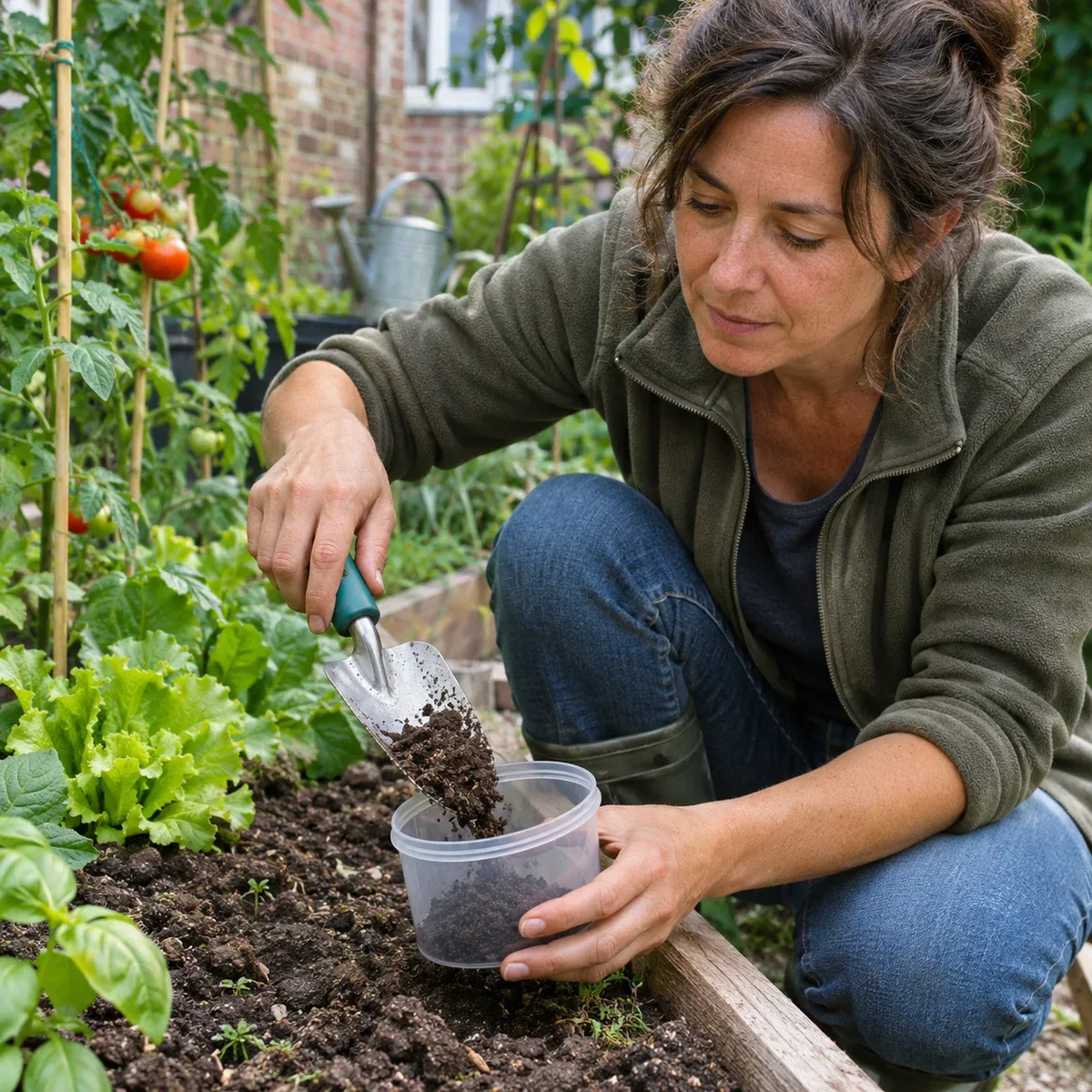
Is a bed or container filled with brought-in soil sufficient?
Growing out of contact with the existing soil may be one of the measures considered, provided the materials’ origin and quality are known. It is also necessary to consider the areas around the bed, dust and water: altering the growing medium does not demonstrate the elimination of all exposure. This limitation stems from transfer pathways and management measures described by REFUGE.
The raised vegetable bed guide helps distinguish installation types; it does not replace this assessment.
Deciding before work begins, then preserving records
Request conclusions that address your intended use, including any conditions and their monitoring. Depending on the site, the decision may lead to adapting the project or choosing another location. Géorisques emphasises preserving records of pollution and management measures. Géorisques, expert dossier
A Parisian case illustrates this: the initial site for a composting project was abandoned after soil contamination was discovered, then the project was reorganised elsewhere with analyses and modifications. This case does not describe the state of other gardens in Paris. City of Paris
Preparing your first contact
Compile the information already described in a single summary to provide to the owner, manager or specialist consulted:
- Site and history: address, former activities, known fill materials or waste deposits, documents and references from consulted archives.
- Project and plan: intended areas, identification of zones in open ground or containers and how the harvests will be used.
- Water and use: water source, individuals using the site and presence of children.
- Available studies: existing reports and the use for which they were conducted.
- Missing information and questions: what remains unknown in the history, followed by the investigations and conclusions to be clarified for your project.
This summary compiles the context; it does not replace appropriate analyses or their interpretation. Keep a copy with responses and received studies.
Sources and references
- R.E.F.U.G.E. Guide: characterisation of contamination in urban soils intended for market gardening and health risk assessmentAgroParisTech / INRA, Anne Barbillon, November 2019 version, Île-de-France case Accessed on 18 October 2026.
- Contaminated and potentially contaminated sites and soilsGéorisques, Ministry for the Environment / BRGM Accessed on 18 October 2026.
- Expert dossier on potentially contaminated sites and soilsGéorisques, Ministry for the Environment / BRGM Accessed on 18 October 2026.
- 10 years of Participatory Budgeting… in the 5th arrondissementVille de Paris Accessed on 18 October 2026.