
The vegetable garden notebook / Techniques
Raised vegetable beds: choosing height and filling
A raised vegetable bed can bring crops closer to your hands. To choose a practical model, first check how you will reach it and whether the plants’ roots will be able to grow down into the garden soil.
Adapt this guidance to your garden’s climate and conditions.
Practical steps
- Distinguish
Identify the base: open to the ground, placed on a slab or supported by legs.
- Test
Try the height, arm reach and access with the person who will garden.
- Prepare
Select the filling and water drainage according to the type of planter.
- Monitor
Check the moisture of the growing medium and adjust watering to the crops and weather.
Raised bed or elevated planter: first consider the base
A low bed can demarcate a crop without making it accessible to someone seated. When choosing your setup, the shape matters less than the working height and the relationship with the soil:
- An open-bottom bed installed on the ground maintains this continuity: roots can grow into the soil beneath. Its preparation therefore also depends on the condition of that soil, as shown by the University of Maryland.
- An elevated planter with a base acts as a container. Roots only have access to the volume you provide; the choice of growing medium is therefore critical. Maryland
- A frame placed on a slab does not offer access to the soil of an open bed. The RHS recommends adapting the filling and providing drainage for excess water.
Before purchasing, sketch the location with its pathways and water source on your vegetable garden plan.
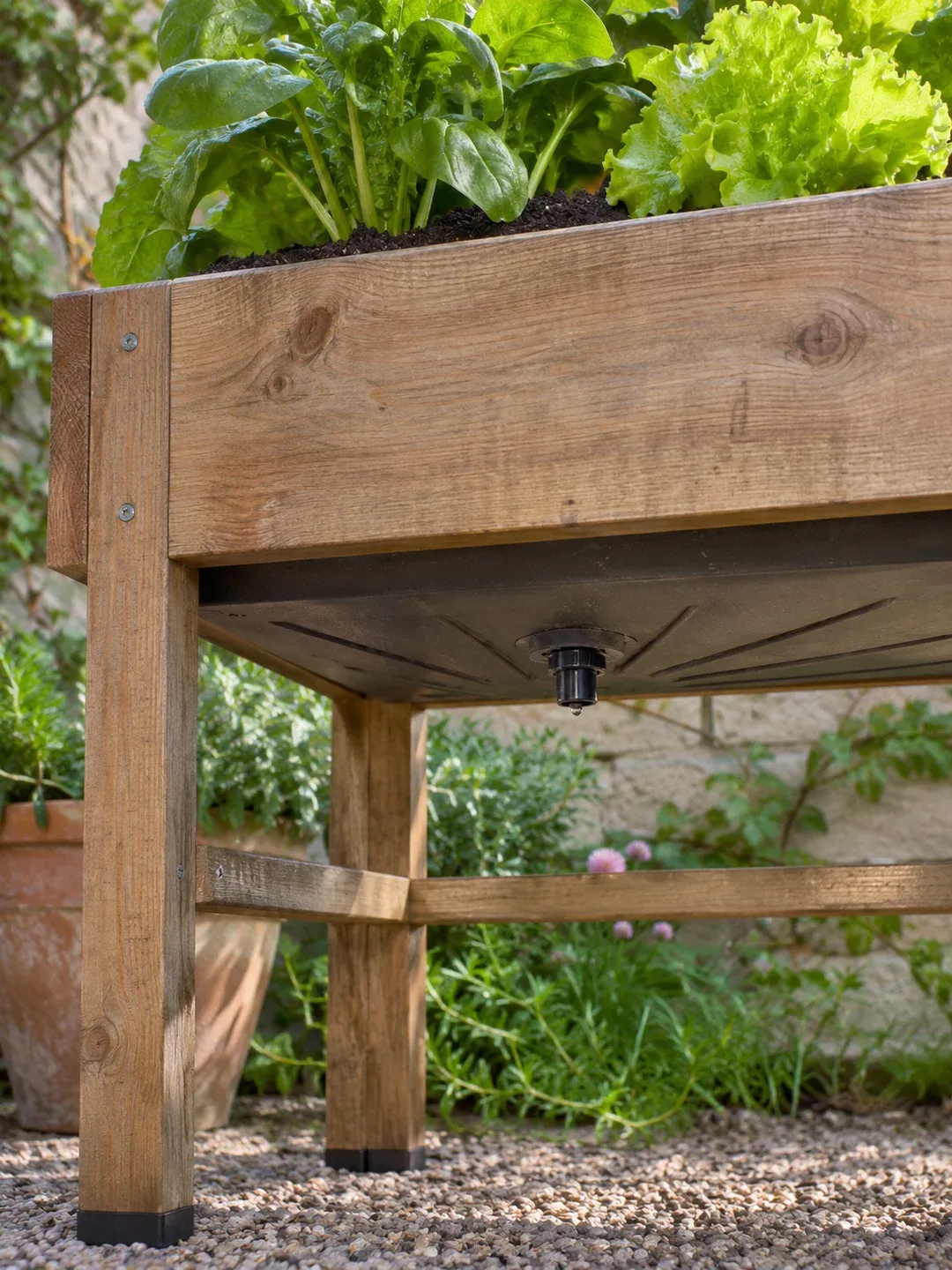
Adjust width and height with the gardener
You must be able to reach the cultivated area without stepping into the bed. Thrive suggests a reach of approximately 50 cm, so a bed up to 1 m wide if accessible from both sides, or 50 cm from one side only. These are starting points to reduce if your comfortable reach is less.
For gardening while standing without bending, Thrive recommends a height of 90 cm to 1 m. Test these dimensions before finalising them: mark out the edge and working surface, then simulate sowing and harvesting. Your height, posture and range of movement take precedence over catalogue measurements.
When seated or in a wheelchair, also check legroom and footrest space. A vertical wall may require working sideways; some elevated planters allow frontal access. Ensure a firm, even, non-slip pathway with enough clearance to turn with your actual equipment. These are criteria developed by Thrive in its accessibility guide.
Separate working height from soil depth
A tall elevated planter may contain only a shallow layer of growing medium. Measure its usable internal depth, then choose crops accordingly. The RHS suggests, for example, 30 cm for cut-and-come-again salad leaves and strawberries in its raised bed advice; this guideline does not automatically suit all crops.
Also check the construction before filling: wall stability, joints, legs and manufacturer’s instructions. Iowa State University notes that soil and plants become particularly heavy after watering. For a balcony or suspended terrace, have the permissible load of the support verified for your project; these horticultural dimensions do not constitute a structural calculation.
Choose materials of known origin. Avoid reclaimed wood of unknown treatment and unidentified demolition materials. The University of Maryland advises against certain old treated woods, including those with creosote or CCA. A reclaimed plank does not become suitable for a vegetable garden simply because it is sturdy.
Fill according to contact with the soil
In an open-bottom bed on the ground, first examine the existing soil: is it compacted, well-draining, already cultivated? Preparation and additions of soil or mature garden compost depend on this condition. The University of Maryland presents several distinct cases; a single filling recipe cannot replace them.
In a planter without access to the ground, choose a medium designed for container growing, capable of retaining water while allowing air to reach the roots. Avoid filling it solely with garden soil: in a container, it can become too dense, particularly in a shallow planter. Maryland
Read the intended use and composition of the product, as well as any fertiliser content. The guide for choosing potting compost details this assessment. No layering is necessary to apply these criteria.
Provide water drainage, then monitor drying
Ensure water can actually drain from the planter or frame placed on a hard surface. A layer of gravel does not create drainage in a closed base. The RHS emphasises drainage openings and moisture monitoring: a raised bed can dry out faster than the surrounding soil, especially in hot, windy weather.
For a planter without access to the ground, check the medium with your finger before deciding to water. When watering is needed, moisten the cultivated volume without multiple shallow applications; allow excess to drain and empty any saucer. The University of Maryland adjusts frequency and quantity to the plant, container volume and exposure.
Record the weather, observed moisture and watering performed to adjust your watering frequency. For nutrition, consider the inputs already present in the potting compost, the crops and the fertiliser label, if any: no uniform schedule suits all planters. Maryland
Sources and references
- Gardening in raised bedsThrive, in English Accessed on 16 October 2026.
- Wheelchair friendly garden designThrive, with Mark Lane, in English Accessed on 16 October 2026.
- Soil to Fill Raised BedsUniversity of Maryland Extension, in English Accessed on 16 October 2026.
- Growing Media (Potting Soil) for ContainersUniversity of Maryland Extension, in English Accessed on 16 October 2026.
- How to make a raised bedRoyal Horticultural Society (RHS), in English Accessed on 16 October 2026.
- Creating Raised Bed PlantersIowa State University Extension and Outreach, in English Accessed on 16 October 2026.
- The Safety of Materials Used for Building Raised BedsUniversity of Maryland Extension, in English Accessed on 16 October 2026.
- Maintaining Container Grown VegetablesUniversity of Maryland Extension, in English Accessed on 16 October 2026.