
The vegetable garden notebook / Techniques
Wood-chip mulch: where should you apply it in the garden?
Wood chips are best suited to areas you disturb infrequently. Before covering a vegetable bed, verify their origin and plan how to clear them for sowing or planting.
Adapt this guidance to your garden’s climate and conditions.
Practical steps
- Identify
Check the wood’s origin and avoid treated or unknown materials.
- Locate
Prioritise paths and established plantings that are rarely disturbed.
- Apply
Keep the chips on the surface, without mixing them into the soil or covering the bases of plants.
- Remove
Clear the area before sowing or planting.
Verify the wood before choosing its location
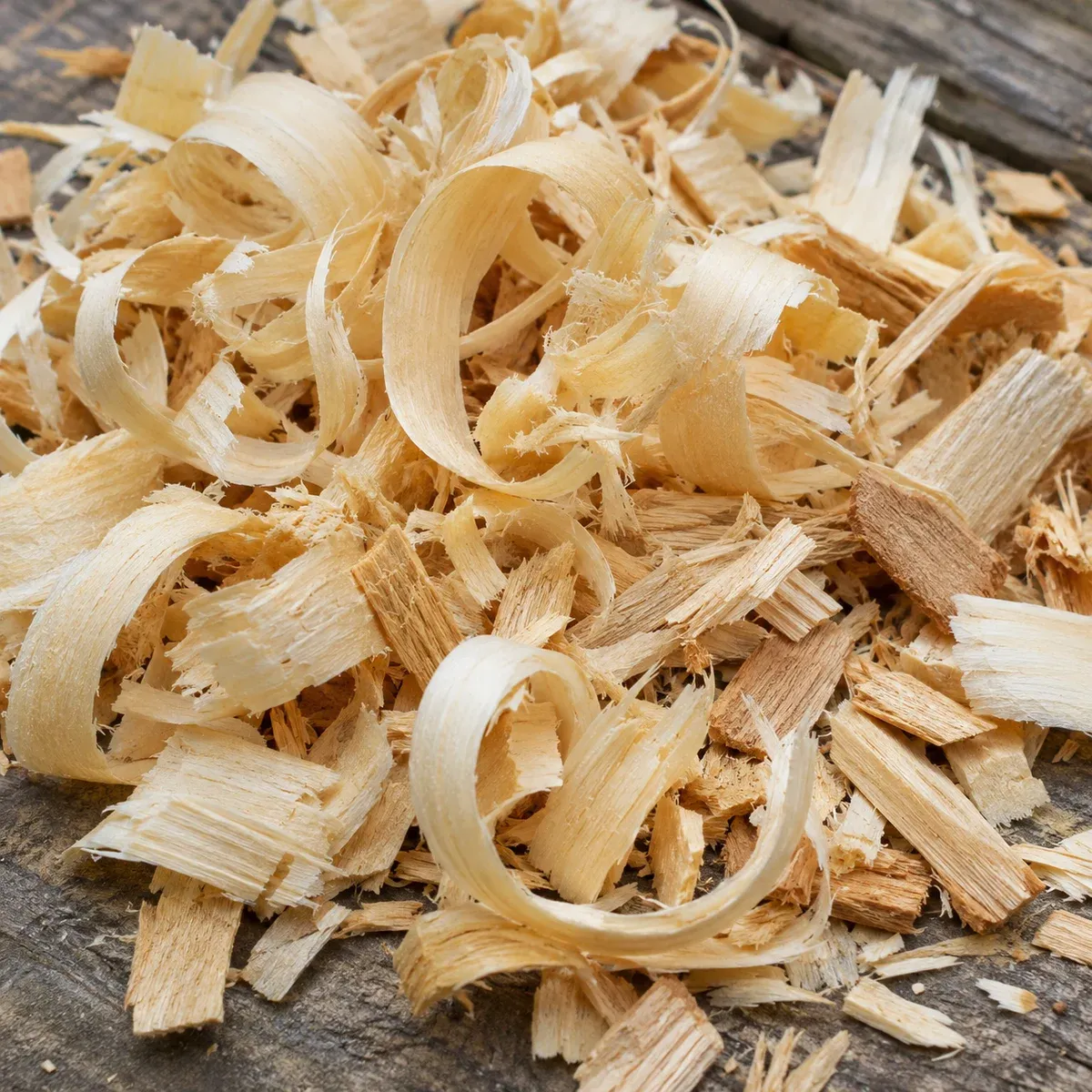
Ask where the batch comes from: garden prunings, shredded prunings, or an identified mulching product. Use untreated raw wood. Avoid unknown demolition waste, treated, painted, or glued wood, and shredded panels. The RHS advises against treated wood and panels containing synthetic resins. Free material of unknown composition does not become good mulch simply because it is chipped.
Not all shredded wood is BRF. Ramial chipped wood comes from fresh small-diameter branches, mainly hardwood; the Jardiner Autrement definition specifies branches no larger than 7 cm in diameter. This refers to the branches before shredding, not the size of the pieces. A delivery of trunk chips therefore does not have the same origin.
Paths, perennial plantings, or vegetable beds?
Wood chips decompose slowly. The Washington State University guide presents them as a durable cover for permanent plantings and illustrates their use in paths between beds. These are good starting locations: you will not need to move the wood for each sowing.
On an annual vegetable bed, the issue is also practical. Iowa State University notes that wood chips can be used there, but their persistence complicates planting and soil work in subsequent years. For a succession of radishes, carrots, or other direct sowings, choose a cover that is easy to remove, from among the materials in the general mulching guide.
A perennial plant is not necessarily already well-rooted. The RHS remains cautious around soft fruit and shallow-rooted vegetables. It also restricts the use of fresh shredded wood to certain established planting situations: for a new bed, prefer an aged material suitable for this purpose.
Do wood chips cause nitrogen drawdown?
Microorganisms use nitrogen to decompose wood. They can thus make some of this nitrogen temporarily less available to plants, as explained by Oregon State University.
The key point is not to bury the chips. The Washington State University guide distinguishes their minimal effect on underlying soil nutrients when left on the surface from the possible reduction in nitrogen availability when incorporated. This does not mean that all wood mulch starves crops, nor that no local effect is possible.
Young plants require more vigilance: Oregon State University highlights their sensitivity to nitrogen competition near the surface. Do not automatically compensate for mulching with fertiliser; the RHS does not recommend systematic additional fertilisation.
Apply the cover without mixing it into the soil
- Weed before application, removing perennials and their underground parts in particular. Mulch does not replace this initial work.
- Check the soil: it should be moist and not frozen, according to the RHS.
- Spread the chips on the surface, then clear the base of plants and emerging shoots.
Weeding and keeping the root collar clear follow the precautions outlined by Jardiner Autrement. Also, maintain a visible separation between the mulched path and the bed: this will help prevent wood from being mixed into the soil with tools.
Example of application with coarse chips
For a well-drained permanent area, use a batch of untreated wood chips from a known source, with large fragments rather than mostly sawdust. The RHS recommends approximately 8 to 12 cm for chips, as larger pieces compact less; this guideline does not apply to a layer of sawdust or all vegetable beds. For a first trial, mark out a small section of path or an area around well-established plantings that meets the precautions described above. RHS, wood
After weeding and checking moisture, spread the layer on the surface and measure it in several places. Keep a clear margin around stems and the bed boundary visible. During inspections, check dispersed or decomposed parts before topping up; the initial thickness does not need to be fully reapplied each year.
Do not set the same thickness for all batches and all soils. Observe the proportion of fine pieces, compaction, and soil moisture. Oregon State University notes that a thick cover can worsen oxygen deficiency in already waterlogged soil. If an area remains saturated, first investigate its drainage.
Monitor water and prepare for subsequent sowings
After rain or watering, move aside some chips to check if the soil is moist. The RHS reminds us that water must reach the roots beneath the cover. The damp appearance of the chips is therefore not sufficient to decide on watering.
Before direct sowing, clear the future row without burying the chips. Do the same before opening a planting hole: Jardiner Autrement advises this removal to avoid mixing mulch and soil in contact with roots. Keep sown rows clear while seedlings emerge.
In permanent locations, observe what remains before renewing the cover. Add only where it has decomposed or dispersed; the RHS describes the renewal of organic mulches as they degrade. Note the batch origin, covered area, and any difficulties encountered: this will make it easier to choose the next use.
Sources and references
- Woody waste: using as a mulchRoyal Horticultural Society (RHS), in English Accessed on 16 October 2026.
- A Home Gardener’s Guide to Soils and Fertilizers, Organic Mulch section, pages 12–13Washington State University Extension, in English Accessed on 16 October 2026.
- What mulches work well for weed suppression in the vegetable garden?Iowa State University Extension and Outreach, in English Accessed on 16 October 2026.
- BRFJardiner Autrement, French National Horticultural Society Accessed on 16 October 2026.
- The effects of mulching in the gardenJardiner Autrement, French National Horticultural Society Accessed on 16 October 2026.
- Mulching Woody Ornamentals with Organic Materials, EC 1629Oregon State University Extension Service, in English Accessed on 16 October 2026.
- Mulches and mulchingRoyal Horticultural Society (RHS), in English Accessed on 16 October 2026.