
The vegetable garden notebook / Techniques
Slate mulch: where to apply it and how to remove it
Slate is best considered for areas where the soil is disturbed infrequently. Before covering a surface, plan for future sowing, adding soil amendments, and retrieving the fragments.
Adapt this guidance to your garden’s climate and conditions.
Practical steps
- Choose the area
Prioritise a permanently planted space with minimal soil disturbance.
- Plan for removal
Identify areas to keep accessible for sowing or adding garden compost.
- Apply to the surface
Weed thoroughly, then distribute the fragments without covering the base of plants.
- Maintain
Observe the soil beneath the slate and remove weeds by hand.
What distinguishes slate from organic mulch
Slate is a compact metamorphic rock that splits into thin plates, according to the British Geological Survey. This structure explains why it is supplied as flat fragments. It does not, however, demonstrate any particular effect on vegetable growth.
The RHS classifies slate as a non-biodegradable mulch. It covers the soil without contributing the organic matter provided by decomposing organic mulches. If your primary goal is to maintain this organic matter, choose an appropriate cover using the general mulching guide.
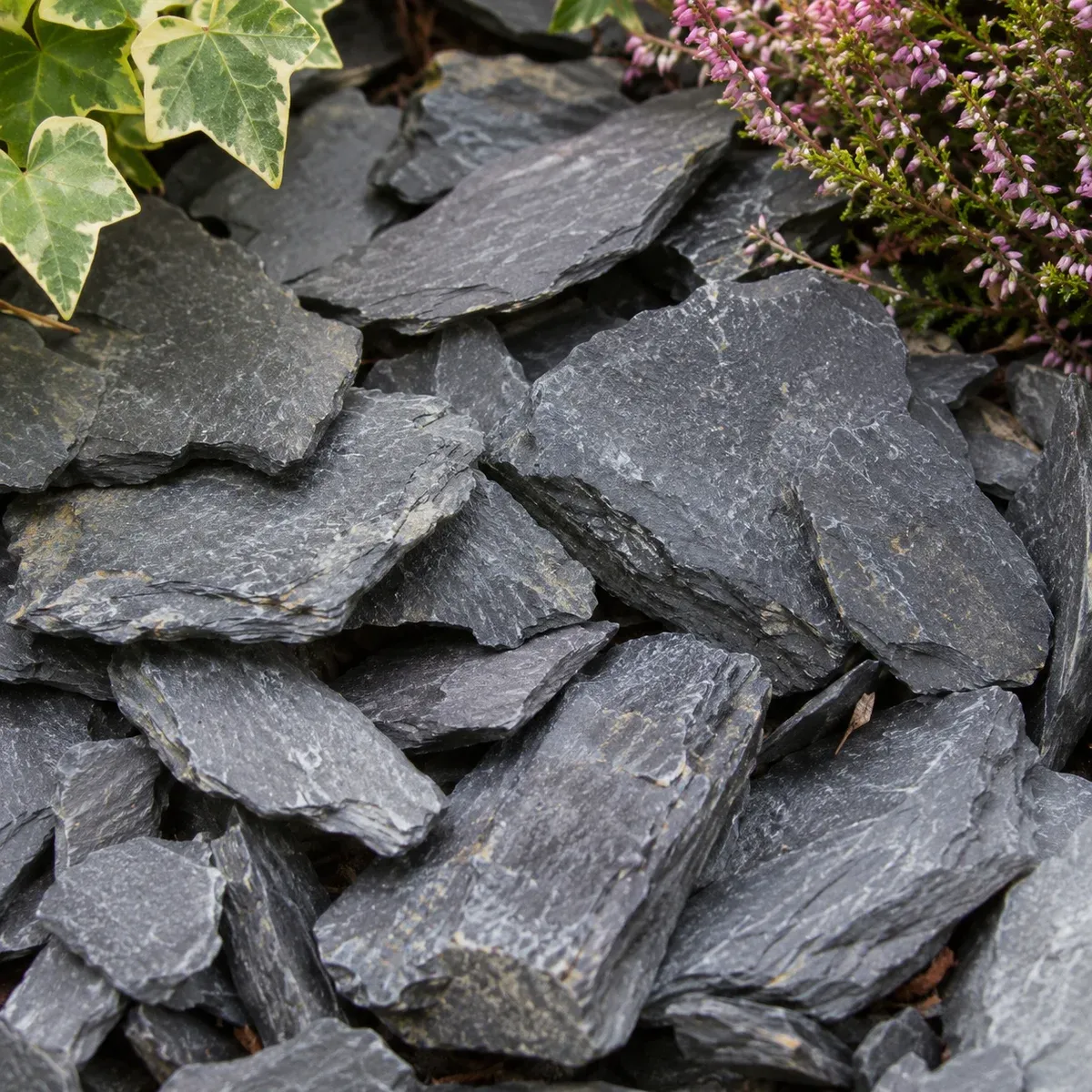
Where is slate practical in the garden?
The decisive criterion is how often you will need to access the soil. Jardins de France emphasises that repeated sowing and transplanting should not be complicated by mulch. Another SNHF fact sheet mainly recommends mineral materials for rock gardens and containers, and advises planning how to retrieve them.
Use this to decide where to try slate:
- A permanently planted area with minimal disturbance is more suitable for testing slate, provided the bases of the plants remain visible.
- A bed where sowing, planting, and root harvesting alternate requires moving the fragments each time you work on the bed: opt for a more manageable cover here.
- An area regularly enriched with garden compost requires soil access to be maintained. Decide before application how you will clear this space.
Laying mulch you can remove later
Start with a small, measured area: for example, a 1 m by 1 m rectangle, chosen as a test zone rather than a required size for growing plants. Mark its boundaries, excluding the spaces left clear around plants from the calculation. Keep the product name, its size grading, and the actual quantity used on this area.
Follow the aggregate manufacturer’s instructions for coverage, then observe the distribution: visible patches of soil, accumulation against plants, and ease of fragment removal. Do not add a thickness intended for straw or bark to compensate for missing guidance; ask the supplier for the recommended coverage for the exact size grading. A bag sold by weight cannot be converted to litres without knowing the material’s properties.
Finally, try clearing the fragments from part of the area into a container. You will see if the recovery process and the quantity handled suit you before extending the coverage. This trial record helps you compare a known batch; it does not show how well all types of slate suppress weeds. Jardins de France stresses this point: a mineral mulch must be recoverable without being buried.
Use an identified slate aggregate with a known origin. The same source only recommends materials that are free from contamination; it does not endorse roofing debris. Do not use slabs or demolition waste of unknown origin.
To install the cover:
- Mark the bases of perennials and areas where you will need to work later. A visible marker helps avoid covering a plant when it loses its foliage.
- Remove unwanted weeds, particularly the roots and rhizomes of perennials: mulch does not replace this preparation.
- Apply to moist, unfrozen soil, as recommended by the RHS.
- Distribute the fragments on the surface, without mixing them into the soil or piling them on shoots or against the root collar, the junction between stem and roots.
The marking of perennials follows Jardins de France; the precautions for weeding and keeping plant bases clear follow Jardiner Autrement. The thicknesses suggested for straw or bark in the bed mulching fact sheet are not prescriptions for slate.
Heat and watering: monitoring the soil beneath the fragments
The RHS indicates that dark materials warm the soil in sunlight. Dark slate therefore warrants caution in already very hot areas.
To decide whether to water, move aside a few fragments and examine the soil. After watering, check that the water reaches the soil beneath the cover. The appearance of the stone does not replace this observation; the watering guide helps you adjust how much water to give according to the crop and actual soil moisture.
Maintaining slate and getting a bed ready for planting again
Remove by hand any weeds that appear around permanent plants, as advised by the RHS. Do not rely on the material’s lifespan to eliminate all weeding.
Before sowing, adding garden compost to the soil, or working the soil, gather the fragments from the relevant area into a container. Then work on the cleared soil. To permanently change the mulch, recover the mineral cover instead of burying it; this approach follows the removal principle recommended by Jardins de France.
If you often need to move the fragments, reduce the area covered with slate. The material remains practical as long as its maintenance fits the work your garden needs.
Sources and references
- BGS Rock Classification Scheme — SlateBritish Geological Survey (BGS), in English Accessed on 16 October 2026.
- Mulches and mulchingRoyal Horticultural Society (RHS), in English Accessed on 16 October 2026.
- Mulching, the gardener’s allyJardins de France, SNHF; Jean-François Coffin Accessed on 16 October 2026.
- Mulching garden bedsJardins de France, SNHF; D. Veschambre and Fabien Robert, Astredhor Accessed on 16 October 2026.
- The effects of mulching in the gardenJardiner Autrement, SNHF Accessed on 16 October 2026.