
The vegetable garden notebook / Techniques
Mineral Mulch: Where to Use It in the Garden and Vegetable Patch
Mineral mulch is well-suited to areas that will remain planted for an extended period. Before covering a vegetable bed, plan for future sowings, harvests, and soil amendments.
Adapt this guidance to your garden’s climate and conditions.
Practical steps
- Choose the area
Identify permanent plantings and beds where the soil will be disturbed.
- Plan for maintenance
Keep access to the soil for weeding, planting, and monitoring moisture.
- Choose a suitable material
Consider the plants, the type of gravel, and the exposure.
- Monitor the soil
Mineral mulch does not provide the organic matter contribution of a plant-based mulch.
Where is mineral mulch beneficial?
Gravel and stone fragments form a long-lasting cover that does not decompose like plant-based mulch. This durability is particularly useful for features you wish to preserve. However, it has a limitation: the material does not contribute to the soil’s organic matter. Utah State University
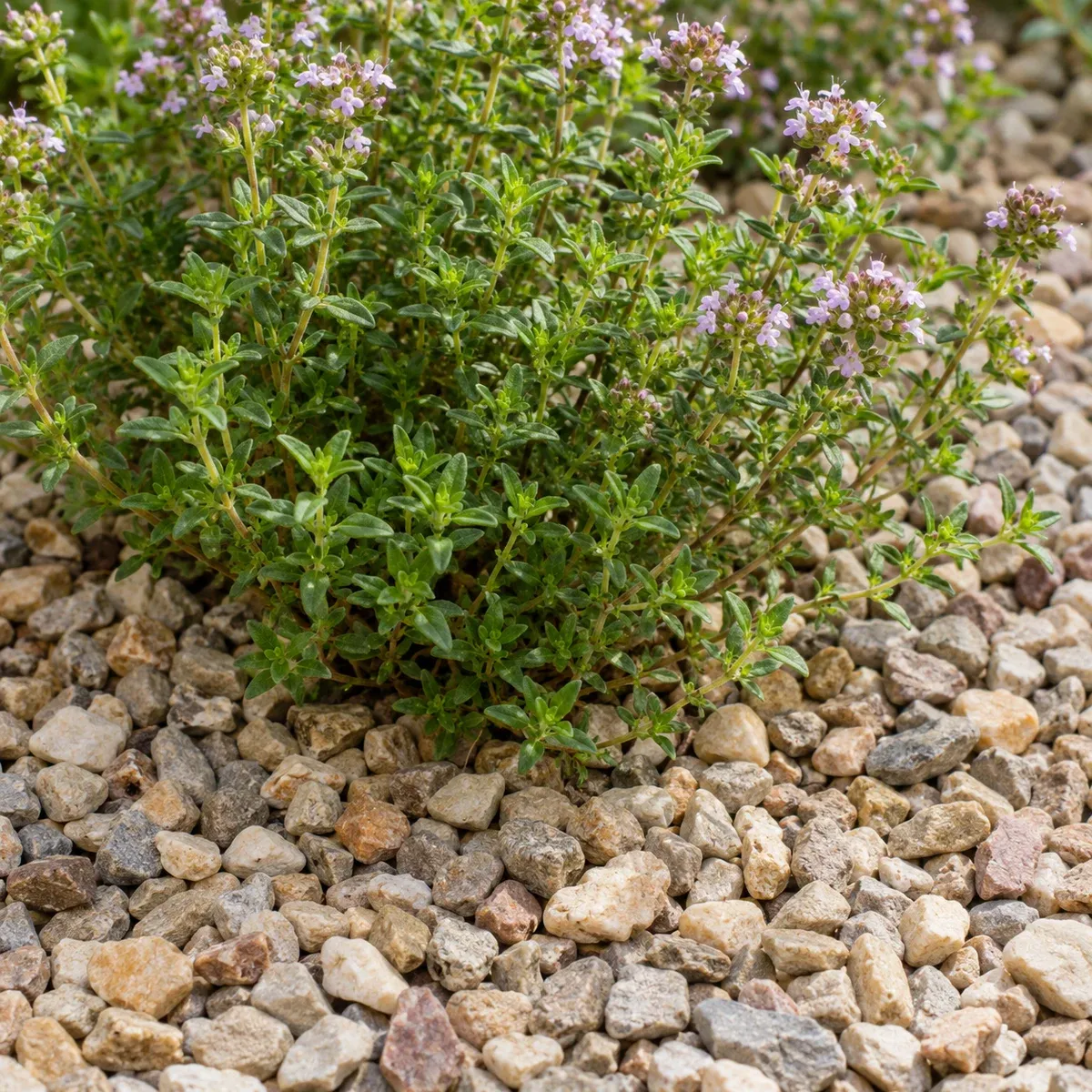
A bed of plants suited to a sunny, well-drained location may be ideal for a gravel garden. The RHS specifically mentions lavenders and cotton lavenders. On heavy, damp soil, it is better to choose plants adapted to the conditions: covering the surface with gravel will not make the site suitable for these plants.
Also, check the type of rock. The same source advises against using limestone gravel near plants that require acidic soil. The choice, therefore, is not based solely on colour.
Why is it less practical for a vegetable bed?
Annual crops need repeated sowing, planting, and other work. Iowa State University notes that mineral mulches can complicate planting, transplanting, and weeding. For a bed where sowing, uprooting, and replanting follow one another, we conclude that a cover that is easy to move is generally more practical.
Before laying the mulch, review your crop rotation and planned tasks: will you need to open furrows or harvest vegetables by lifting the soil? If these operations are frequent, reserve mineral mulch for another area. This caution concerns access to the soil; it does not mean that vegetables cannot grow under mineral mulch.
For annual beds, Iowa State University suggests straw without seeds and shredded leaves. The general mulching guide helps in selecting and preparing these materials.
Mineral or organic: what happens to fertility?
Plant-based mulch decomposes and can enrich the soil with organic matter. Mineral mulch persists but does not provide this contribution. Utah State University distinguishes these functions: covering the soil and maintaining its fertility are two separate decisions.
If you plan to add compost, consider from the outset how you will access the soil. The lack of organic input from gravel does not justify an automatic dose of fertiliser: assess the needs of the crop and the condition of the soil.
Does stone always warm the soil?
The effects depend on the materials and their exposure. The RHS states that a dark material warms the soil in sunlight, while white gravel reflects light and can keep roots cooler in full sun.
Similarly, reducing evaporation under mulch does not tell you how much water your vegetable patch will save. Check the soil beneath the mulch and ensure water reaches the root zone, as recommended by the RHS. Base your watering on these observations.
How should you plan for installation and maintenance?
- Weed before covering. Mulching does not replace the removal of existing weeds. Iowa State University
- Keep plants clear. Do not bury young shoots under gravel or pile the material against stems. RHS
- Plan for regular weeding. Soil and organic debris can accumulate between stones, allowing new weeds to emerge. Iowa State University
A membrane beneath the gravel is not an automatic step. It can facilitate separation from the soil, but weeds may still establish on top; some covers, particularly plastic films, also restrict water and air exchange. Consider these limitations before making future garden work more difficult. Iowa State University
A trial for a durable border
For example, a border of thyme or rosemary, in full sun on already well-drained soil, matches the plants cited for gravel gardens by the RHS. Reserve this trial for established plants, keeping their base clear; do not automatically extend the gravel into neighbouring annual rows.
For this area, medium-sized, angular gravel is easier to walk on, according to the RHS. Their example calculation uses a 5 cm layer, which represents 50 litres per square metre, to be verified against the coverage stated for the product. This is a sizing guideline for gravel, not a thickness applicable to all rocks and small plants.
Clearly mark the border to identify where cultivated soil begins. Keep the mineral mulch on the surface: before planting or adding compost if a need is identified, move the gravel from the area onto a sheet or tray, work the soil, then replace the mulch. This proposed method avoids intentionally mixing stones into the soil. Without a membrane, it will require care each time you work on the area.
Remove accumulations of soil and debris and young weeds before they establish. Iowa notes that these deposits can create a germination medium above the mineral mulch. Start with a limited area and also assess the time required for removal and cleaning before extending the cover.
Sources and references
- Mulches and mulchingRoyal Horticultural Society, in English Accessed on 16 October 2026.
- Gravel gardensRoyal Horticultural Society, in English Accessed on 16 October 2026.
- Water-Wise Landscaping: MulchUtah State University Extension; Heidi A. Kratsch, in English Accessed on 16 October 2026.
- Using Mulch in the GardenIowa State University Extension and Outreach; Aaron Steil, in English Accessed on 16 October 2026.
- How do I control weeds in my garden?Iowa State University Extension and Outreach, in English Accessed on 16 October 2026.