
The vegetable garden notebook / Techniques
What to plant next to courgettes? Choose based on space
A useful neighbour allows the courgette to grow while enabling you to water and harvest it. Start by accounting for the mature plant’s size, then decide if the remaining space suits a temporary crop, border or pathway.
Adapt this guidance to your garden’s climate and conditions.
Practical steps
- Allocate
Map out the mature courgette’s space and your access to the fruits.
- Compare
Check the neighbour’s height, water needs and duration in the ground.
- Arrange
Plan to remove quick-growing crops before the courgette crowds them out.
- Observe
Note access to flowers, insect visits and fruit development.
Allocate space for the courgette before choosing its neighbours
The courgette forms a large plant, even if it does not sprawl across the ground. The RHS distinguishes between compact and trailing varieties and recommends at least 90 cm between two courgette plants, adjusted for the variety. This guideline is not a universal distance between courgettes and any neighbour.
On your plan, reserve enough growing space for it in full sun. Include the pathway to reach the fruits and the base with a watering can: access is part of the Maryland planning recommendations. An empty space around a young plant can already be reserved for its future foliage.
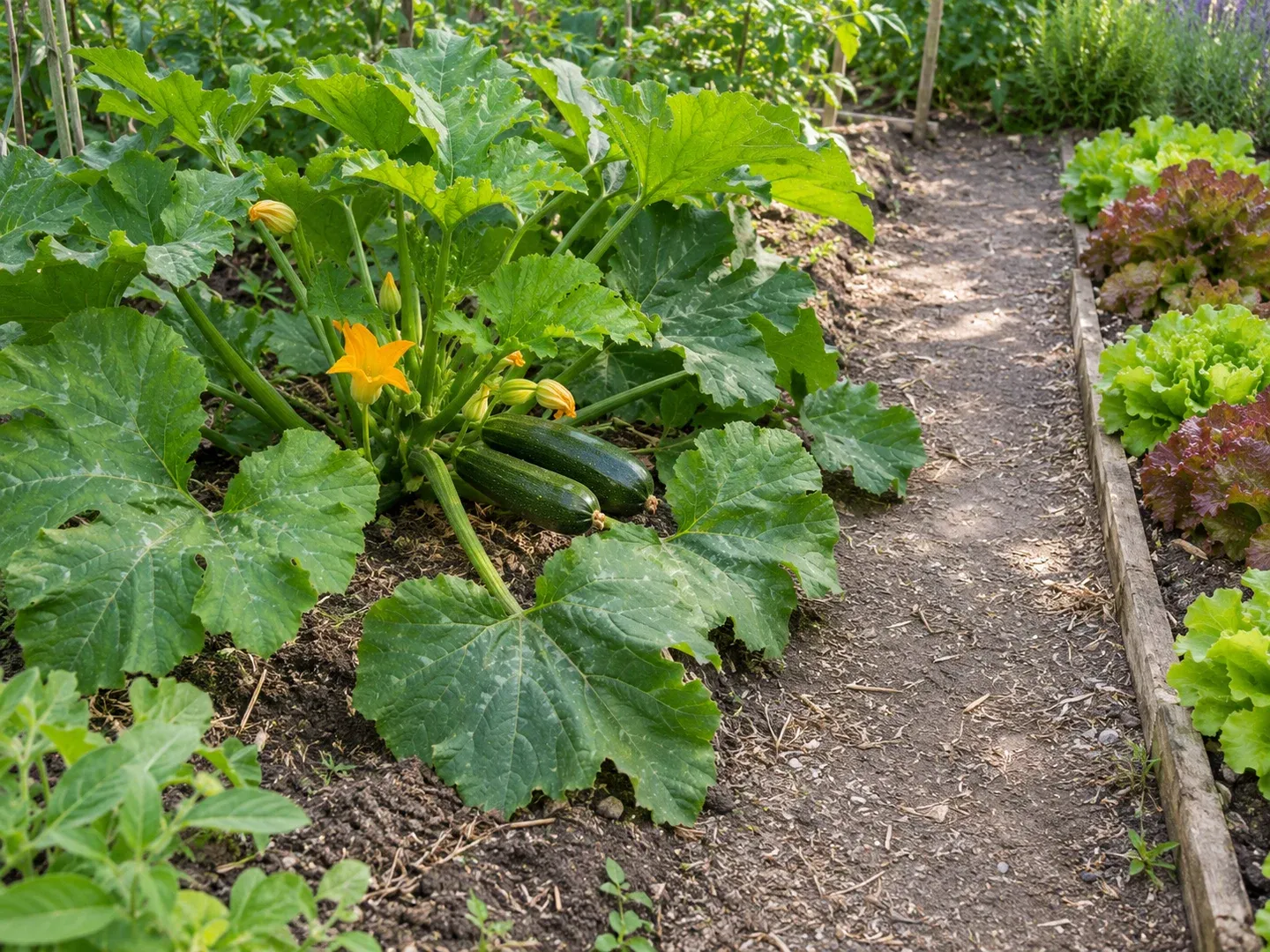
Lettuces and radishes: planning for temporary companions
A lettuce or small radish may be considered in temporarily free space if harvested before the courgette becomes too large. This is a practical arrangement to test in your own garden. The RHS describes this principle with fast-growing crops between slower, larger ones, such as maize, but does not provide evidence of a specific benefit for the courgette–lettuce or courgette–radish pairing.
Before sowing, compare the suitable period for your variety, its growing duration and the courgette’s current development. Do not assume that a crop that starts small will still have enough space all summer. If the harvest is likely to occur too late, choose another border or harvest the first crop before planting the courgette: this creates a succession. The criteria for duration, light and development proposed by Maryland help distinguish these options.
Tomatoes, climbing French beans and maize: check shade and access
These tall crops require planning for their support and mature size. Maryland recommends arranging tall crops to avoid shading smaller sun-loving plants. Apply this principle to your courgette: observe the sun’s path and plan access to the neighbour’s stake or trellis.
To decide, compare your plan with three practical scenarios:
- The neighbour’s foliage blocks the intended pathway: space the planting positions further apart or reduce the number of plants.
- A trellis shades the courgette: relocate the support before planting.
- Two crops require different watering regimes: ensure you can reach their soil separately.
Comparing water needs is part of selecting companion plants, as Maryland notes. Courgettes prefer consistent moisture, especially during fruiting, according to the RHS. A neighbour does not replace this monitoring. The courgette watering guide details this process.
Flowers near courgettes: what benefit is actually studied?
First, check access to flowers. Under glass or cloches, the RHS advises opening doors and vents in hot weather; hand pollination may still be necessary if insects struggle to reach the plants. Ventilation also matters. A fruit may stop growing for several reasons: adding flowers does not address all unfavourable conditions.
The value of floral resources for insects must be distinguished from a proven yield increase for a specific plant pairing. A study by Knapp and colleagues was conducted on ‘Tosca’ courgettes in open fields in Cornwall in 2016 and 2017. In 2017 surveys comparing the crop and borders, Bombus terrestris/lucorum bumblebees were more abundant in the crop in the morning, then in the borders in the afternoon after flowers closed. Commercial colonies were added in 2017.
This work combines observations and population simulations. It highlights the complementarity of floral resources but does not establish that a specific flower planted at the base of a courgette increases its yield. A flowering border can thus be part of your project, with its own space; these results provide neither a mandatory companion species nor a planting distance.
Courgettes and cucumbers: do not confuse proximity with cross-pollination
Cucumbers (Cucumis sativus) do not cross-pollinate with courgettes (Cucurbita pepo). Their proximity is therefore judged by space and care, without fear of producing a fruit that is half-cucumber, half-courgette. However, varieties within Cucurbita pepo, such as courgettes and pattypan squash, can cross-pollinate. Iowa State University
This cross-pollination affects seeds and the plants grown from them if resown; it does not alter the characteristics of the courgette harvested this year. This distinction does not mean pollination is unimportant for fruit development: it separates the formation of the current fruit from the heredity of the next generation. Iowa State University
For your next plan, note the chosen neighbour, its removal date, observed shade and access difficulties. The companion planting guide and its interactive fact-sheet matrix help distinguish practical organisation from a studied effect, without turning an untested association into an incompatibility.
Sources and references
- How to grow courgettesRoyal Horticultural Society (RHS), in English Accessed on 16 October 2026.
- Planning a Vegetable GardenUniversity of Maryland Extension, in English Accessed on 16 October 2026.
- Vegetable Succession and Companion PlantingUniversity of Maryland Extension, in English Accessed on 16 October 2026.
- Three ways to use companion plantingRoyal Horticultural Society (RHS), Guy Barter, in English Accessed on 16 October 2026.
- Courgette, marrow, pumpkin and squash problemsRoyal Horticultural Society (RHS), in English Accessed on 16 October 2026.
- Bombus terrestris in a mass-flowering pollinator-dependent crop: A mutualistic relationship?Knapp et al., Ecology and Evolution, in English Accessed on 16 October 2026.
- Cross-Pollination Between Vine CropsIowa State University Extension, Aaron Steil and Linda Naeve, in English Accessed on 16 October 2026.