
The vegetable garden notebook / Crops
Yardlong bean: warmth, trellis and young pods
Yardlong beans need a reliably warm growing season. Before allocating a trellis, verify the seed identity and the stated growing period for your variety.
Adapt this guidance to your garden’s climate and conditions.
Identifying Vigna and selecting a variety for the season
Yardlong beans, also known as asparagus beans, belong to Vigna unguiculata, Sesquipedalis Group, often presented as the subspecies sesquipedalis. This is not a variety of the common bean, Phaseolus vulgaris. They are related to cowpeas, many of which are cultivated primarily for their seeds. UF/IFAS
Check the seed packet for the use “young pods”, growth habit, and earliness. Varieties may differ in their development and onset of flowering; a trial by National Taiwan University distinguishes climbing and dwarf types. NTU Do not select solely based on the most spectacular pod.
To assess feasibility, also note the starting point of the stated growing period: from sowing or from transplanting a young plant. Purdue gives a guide of 65 to 80 days from sowing to the first harvest for yardlong beans under the method and conditions described in its factsheet. This American figure does not predict your harvest in France; a few mild weeks after the final frost are not the full warm growing season these beans need.
Compare the cultivar-specific indication with the warm period your location typically offers, then verify the conditions for the current year. If the supplier does not specify the duration or its starting point, request this information before dedicating an entire trellis to the trial. A plant started under cover may advance the start but does not replace the subsequent warmth required. Record sowing, first flowers, and first pods: you will have a local benchmark for the next selection, without converting a tropical cycle into a national calendar.
Waiting for sustained warmth, then sowing
Warmth is essential for growth; cold, frost, and waterlogged soil are unfavourable. UF/IFAS In France, consider the end of local frosts, soil warmth and whether enough of the growing season remains for the time stated for your variety. Floridian crop successions do not provide a calendar for your garden. For a first trial, allocate a small space while keeping the option to compare with a common bean.
The home gardening guide from Purdue suggests, for this Vigna, approximately 30 cm between seeds, 60 to 90 cm between rows, and 1 to 2.5 cm in depth. This benchmark differs from professional densities in Florida; compare it with the seed packet. Label the variety and date, then monitor seedling emergence without waterlogging the row. The USDA guide notes emergence in about one week, with variations depending on growing conditions. USDA
Container-raised seedlings are another option: UF/IFAS describes planting them out at the two true-leaf stage. UF/IFAS Prepare the planting site before this stage; keeping a seedling in a small pot indefinitely will not make the outdoor growing season warm enough.
Installing the trellis in well-drained soil
Choose full sun and soil that drains excess water, prepared with well-rotted garden compost if necessary. UF/IFAS, garden For climbing varieties, install a sturdy trellis before the stems elongate; allow access to both sides for harvesting. The USDA guide advises guiding stems to their support early and maintaining an accessible height. USDA
This guide covers growing in the ground. The sources used here do not establish a suitable final pot size for this group; do not automatically use the dimensions for a pot of common beans. Under cover, ensure you can access the trellis and manage water and ventilation during growth.
Watering for tender pods and limiting nitrogen
Tolerance to some drought does not mean a harvest without water: overly dry soil may produce shorter, fibrous pods. The USDA guide advises against soil overloaded with nitrogen, which favours foliage at the expense of pods. USDA
Maintain consistent moisture without waterlogging; mulching helps retain water and suppress weeds. UF/IFAS, garden Check under the mulch before watering. Record dry spells and pod quality separately to avoid conclusions based solely on foliage vigour.
Observing flowers and harvesting before seed swelling
The research summary from National Taiwan University describes yardlong beans as capable of self-pollination. This does not guarantee the absence of cross-pollination between plants. The lack of pods does not automatically call for the pollination advice applicable to runner beans. Compare the variety, development, temperatures, and soil condition to monitor the arrival of the first flowers.
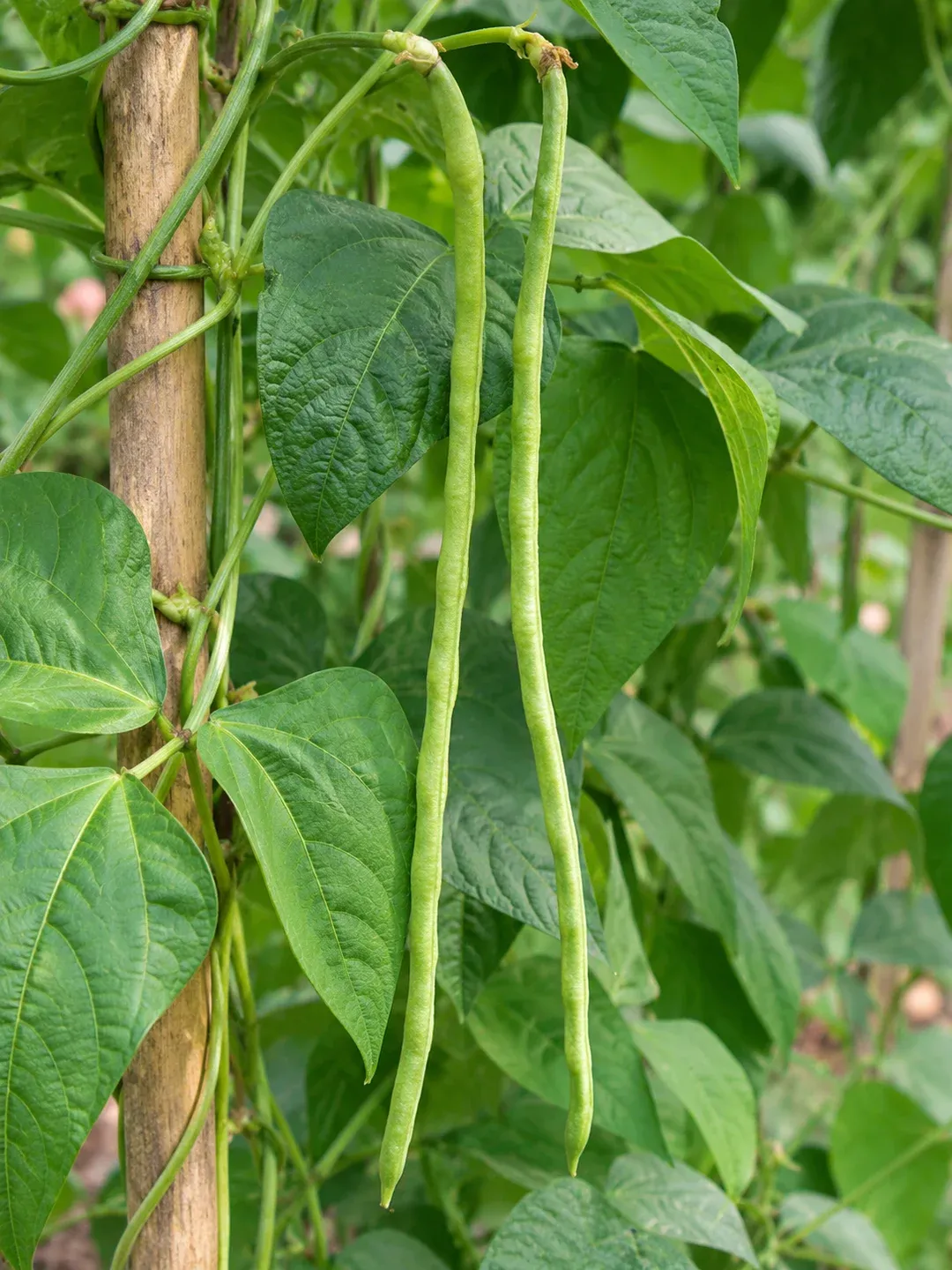
Harvest immature pods before the seeds develop: waiting for maximum length means missing the tender stage. Purdue Return regularly and detach them carefully, by hand or with scissors. UF/IFAS, garden A green or red colour alone is insufficient to determine the stage: observe primarily seeds and texture.
Storing the harvest and renewing the crop
Pods keep for a few days in the refrigerator but are best used quickly. Mature seeds can also be dried for separate use; do not confuse them with young pods. USDA Cook the beans properly and do not taste them raw in the garden: the BfR reminds us of the necessary precautions for beans. BfR This guide does not provide recipes for preserving or cooking the seeds.
The plant is annual and sensitive to cold. UF/IFAS Note the final harvests before the end of the season, then plan a new sowing for the following year.
Monitoring young shoots and leaves
The USDA guide highlights aphids, thrips, and mites on this crop. USDA Inspect shoots, the undersides of leaves, and pods: the presence of insects, fine stippling and distorted growth warrant observation, not automatic treatment. Also photograph the entire plant to show progression.
Use healthy seeds, avoid handling wet plants, and maintain airflow around the foliage. Change the growing location, taking account of other members of the Fabaceae family: replacing a bean with a Vigna does not alone constitute a family rotation. Minnesota, prevention
Key points for this crop
Practical guidance
- Identity
- Vigna unguiculata, Sesquipedalis Group
- Exposure
- Full sun, well-drained and warmed soil
- Support
- Sturdy trellis for climbing varieties
- Harvesting
- Tender pods before seed swelling
Sources and references
- Long Bean—an Asian Vegetable Emerging in Florida, HS1268University of Florida IFAS Extension, in English Accessed on 18 October 2026.
- HO-175: Growing Beans in the Home Vegetable GardenPurdue University Extension, in English Accessed on 18 October 2026.
- Growing Summer Vegetables in Hernando County — Yard Long BeansUniversity of Florida IFAS Extension, William Lester, 31 July 2023, in English Accessed on 18 October 2026.
- Plant Guide: Yardlong BeanUSDA NRCS and University of California at Davis Small Farm Research Center, John H. Lawrence and Lincoln M. Moore, in English Accessed on 18 October 2026.
- The Reproductive Development, Anther Dehiscence and Pollen Viability of Yard-long BeanNational Taiwan University, Wu Pei-Jhen, 2011, original abstract in English Accessed on 18 October 2026.
- Only eat beans after cooking themBundesinstitut für Risikobewertung (BfR), in German Accessed on 18 October 2026.
- Managing plant diseases in the home gardenUniversity of Minnesota Extension, Marissa Schuh and Michelle Grabowski, revised 2026, in English Accessed on 18 October 2026.