
The vegetable garden notebook / Crops
Runner beans: sowing, support and harvest
Runner beans adorn supports and produce edible pods, but fruit set may suffer in extreme heat. Select a variety before organising sowing and harvests.
Adapt this guidance to your garden’s climate and conditions.
Choosing a runner bean for the garden
Phaseolus coccineus is a species distinct from the common bean, Phaseolus vulgaris. Choose a variety known for its tender pods if you wish to cook them whole. Wisconsin
Check the growth habit. For containers, horticultural adviser Andy Vernon recommends the dwarf variety ‘Hestia’; climbing types require a securely fixed structure. RHS, experience Flower colour does not replace this information. Keep the variety name and intended use from the seed packet.
Sowing after frosts and preparing supports
Select a sunny, sheltered spot in soil enriched with well-rotted garden compost. Install the support before sowing: a firmly anchored trellis avoids disturbing the roots later. RHS, experience
The RHS waits until after frosts and for soil to reach 12 °C before outdoor sowing. Their method uses a depth of 5 cm, with two seeds sown at the base of each cane and then thinned to one plant. They space the canes 15 to 30 cm apart, with 45 to 60 cm between the two rows of canes in the support; for dwarf varieties, they recommend 30 cm between plants and 50 cm between rows. Adjust this layout according to your variety’s instructions and leave space for harvesting.
For climbing varieties, the RHS describes canes approximately 2.5 m tall, assembled and anchored before sowing. Verify the mature height of your variety and your access for harvesting: a dwarf cultivar like ‘Hestia’ does not require this size. The RHS also advises cutting back growth that exceeds the top of the support to keep vegetation within reach, without guaranteeing that a small structure will suffice for all climbers. RHS
Starting in individual pots is also possible; harden off the young plants before planting out after frosts. Wisconsin notes seedling emergence in 7 to 14 days, varying with conditions. Cotyledons remain below ground: their absence above soil is normal for this species. Wisconsin Record sowing and emergence dates separately; British months do not determine your local timing.
Monitoring water, growth and containers
Runner beans require water during flowering and pod elongation. Mulch to slow drying; avoid excessive nitrogen, which promotes foliage. Wisconsin In dry periods, check soil under mulch before watering and ensure water reaches the root zone.
For containers, the RHS specifies 30 to 45 cm width for dwarf varieties, and 75 cm width by 45 cm depth for climbers, with a stable pot beneath the support. They distinguish nutrition in soil from that in containers: use a potassium-rich feed for potted plants from the first flowers, following the chosen product’s instructions. RHS These dimensions do not describe small seedling pots. Monitor containers for drying more frequently than garden beds and guide stems towards the support.
Flowers without pods: observe heat and insects
Runner beans prefer cool summers over prolonged extreme heat. Bees contribute to pollination; their presence affects fruit set. Maryland Some selections share ancestry with the common bean and exhibit better self-fertility, such as ‘Firelight’: do not generalise this behaviour to all runner beans. RHS
If a plant flowers without producing pods, note the weather, soil moisture, and insect visits over several days. Compare plants from the same sowing before attributing failure to disease.
Harvesting pods or letting beans mature
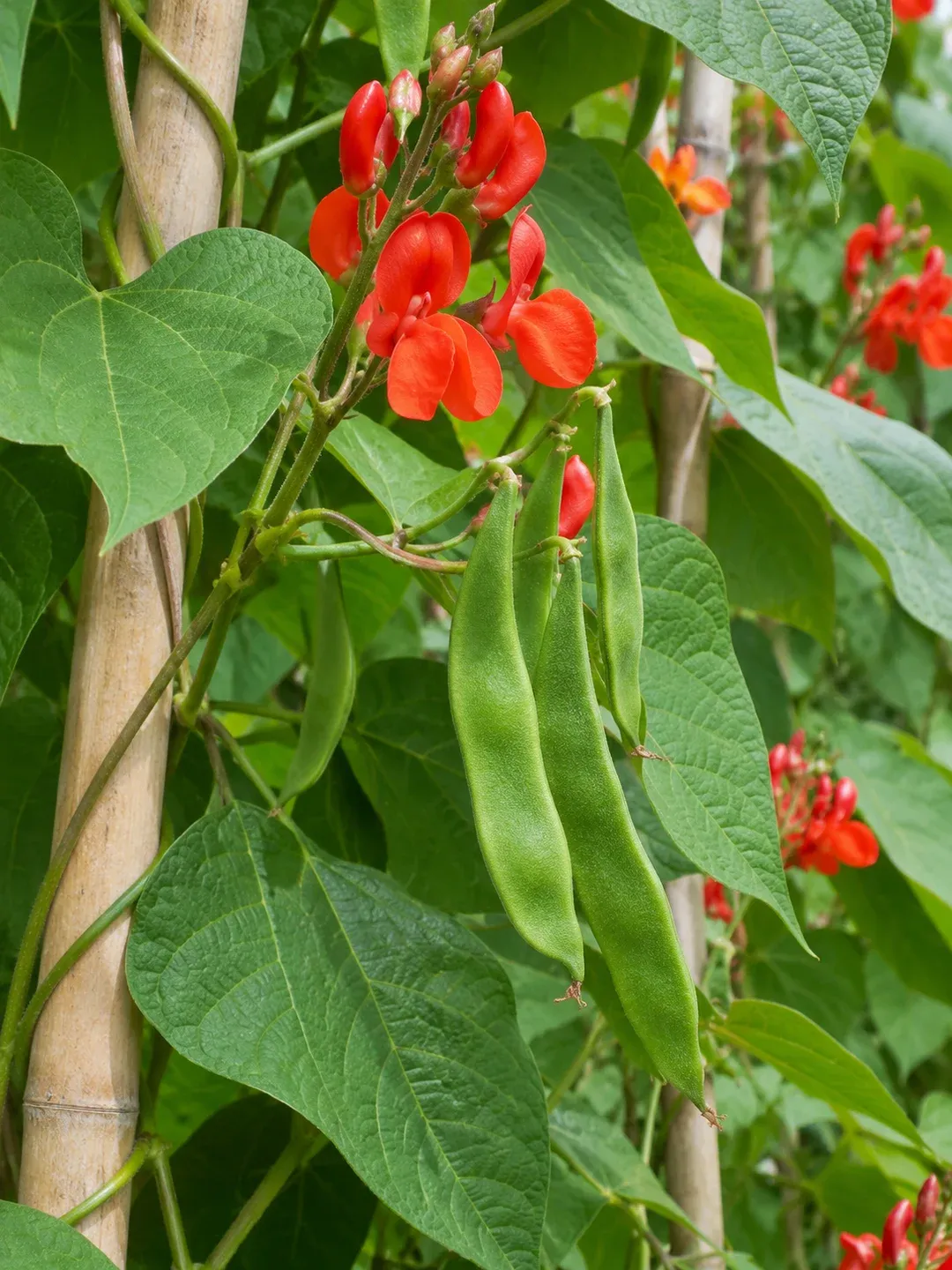
For pods, harvest them young, while still tender and stringless. Cut the pod stalk with scissors rather than pulling on the stem and flower cluster: the Notcutts garden centre guide describes this method to protect flowers and neighbouring young pods. Identify the pod’s attachment before cutting, without severing the supporting stem. For beans, reserve pods for fresh shelling or drying: these harvests correspond to different stages. For seeds, Wisconsin waits for dry pods where beans rattle freely; they also note cross-pollination between varieties. Wisconsin Use fresh pods promptly; dry storage applies to fully mature, completely dry beans. Label separately what you keep for resowing.
Do not taste raw pods or beans. The BfR notes that beans contain lectins and require sufficient cooking; gentle cooking that leaves them merely crisp does not guarantee safety. BfR For preparation and food preservation, follow a reliable method suited to the bean and its fresh or dry state. This guide does not give a universal cooking or canning time.
Inspecting leaves and preparing for the next season
As seedlings emerge, check the young plants for slug damage. Wisconsin Later, inspect the undersides of leaves. Pustules that start pale, then turn brown or black, may indicate Phaseolus rust; a single spot is insufficient for diagnosis. Remove heavily affected debris and do not save seeds from rust-infected crops. RHS, rust
Plan a different location in your crop rotation and avoid working with wet foliage: these are general preventive measures. Minnesota, prevention The tuberous rootstock may be perennial in favourable climates, but foliage does not tolerate frost. Wisconsin For garden planning, therefore, prepare for renewal in spring; the plant’s survival should not dictate the entire next season.
Key points for this crop
Practical guidance
- Species
- Phaseolus coccineus, distinct from the common bean
- Planting
- After frosts, with support already in place
- Growth habit
- Mostly climbing; some dwarf varieties
- Harvest
- Young pods or beans, always intended for cooking
Sources and references
- How to grow runner beansRoyal Horticultural Society (RHS), in English Accessed on 18 October 2026.
- Scarlet Runner Bean, Phaseolus coccineusUniversity of Wisconsin–Madison Extension, Susan Mahr, revised June 2026, in English Accessed on 18 October 2026.
- Growing runner beans: secrets of successRHS, Andy Vernon, horticultural adviser, in English Accessed on 18 October 2026.
- Growing Beans in a Home GardenUniversity of Maryland Extension, updated 20 January 2026, in English Accessed on 18 October 2026.
- Runner and French bean rustRoyal Horticultural Society (RHS), in English Accessed on 18 October 2026.
- Only eat beans after cooking themBundesinstitut für Risikobewertung (BfR), in German Accessed on 18 October 2026.
- Managing plant diseases in the home gardenUniversity of Minnesota Extension, Marissa Schuh and Michelle Grabowski, revised 2026, in English Accessed on 18 October 2026.
- How to grow your own runner beans — HarvestingNotcutts, garden centre and nursery, in English Accessed on 8 November 2026.