
The vegetable garden notebook / Crops
Lima beans: choosing the season and harvesting
Lima beans are grown for their shelled beans. Their need for warmth and a long growing season makes variety choice crucial, especially where summers are short.
Adapt this guidance to your garden’s climate and conditions.
Choosing Lima beans for shelling
The Lima bean is Phaseolus lunatus. It differs from the common bean, Phaseolus vulgaris, runner beans and yardlong beans (Vigna). Lima beans are shelled and harvested fresh or dried. Minnesota
Choose seed of a food variety suited to the length of your growing season. Dwarf and small-seeded types may mature earlier than large climbing varieties. Do not rely on sales names alone: note the growth habit and stated time to maturity. Purdue Where summers are short or cool, treat this as a small trial at first: the date of the last frost does not tell you whether there will be enough warmth.
Waiting for warm soil and avoiding waterlogged ground
The Lima bean requires more warmth and a longer season than the common bean; a cool summer can significantly limit its success. Well-drained, relatively light soil suits it best. Minnesota
Maryland suggests a soil temperature of around 18 °C for five days as a benchmark for good germination. It highlights the sensitivity of large seeds to soil-borne fungi and bacteria. Therefore, wait for a consistently favourable period after frosts, rather than sowing in cold, waterlogged soil.
This is a guide to sowing conditions, not a guarantee of a harvest in France. Check whether the warm part of your growing season is long enough for the variety; do not simply copy American sowing months. If in doubt, ask the seed supplier about experience growing it in a climate similar to yours.
Sowing according to growth habit and installing support
The home gardening fact sheet from Purdue indicates a sowing depth of approximately 1 to 2.5 cm, depending on soil texture. It gives different spacings: 8 to 10 cm for small ‘baby lima’ types, 15 cm for dwarf varieties, and about 25 cm for climbing types. These guidelines do not replace the instructions for your specific variety. For dwarf varieties, Maryland suggests approximately 45 to 75 cm between rows. Maryland
Sow in a sunny location, mark the rows, and keep the soil moist without saturating it. Install trellises for climbing varieties at sowing; dwarf varieties do not require this support. Minnesota Plan where the support and access for harvesting will go before sowing.
The sources cited mainly concern growing Lima beans in the ground. They do not establish a final pot size for container growing; using a small pot to start seedlings does not show that the whole crop can be grown in a container.
Watering and feeding through to pod development
Maintain root zone moisture during dry periods, with extra attention as pods develop. Remove young weeds and mulch the sides of the row. Excess nitrogen can delay flowering: do not add fertiliser based solely on observations of low productivity. Maryland
Before intervening, note the growth stage, soil condition, and recent development. Poor emergence after a cold spell, a leafy plant with no flowers, and pods still filling out call for different checks.
Flowering: distinguishing pollination from unfavourable weather
Lima beans can self-pollinate, but insects may also cause cross-pollination between varieties: seeds you save yourself are therefore not guaranteed to come true to type. Seed Savers Connect
Cold, wet spells, or conversely, very hot and dry periods, can cause flower drop. Maryland If pods are scarce, record these episodes and root zone moisture before assuming a lack of bees. Observe multiple plants and subsequent flowers; manual pollination is not justified by this symptom alone.
Harvesting fresh beans or letting them dry
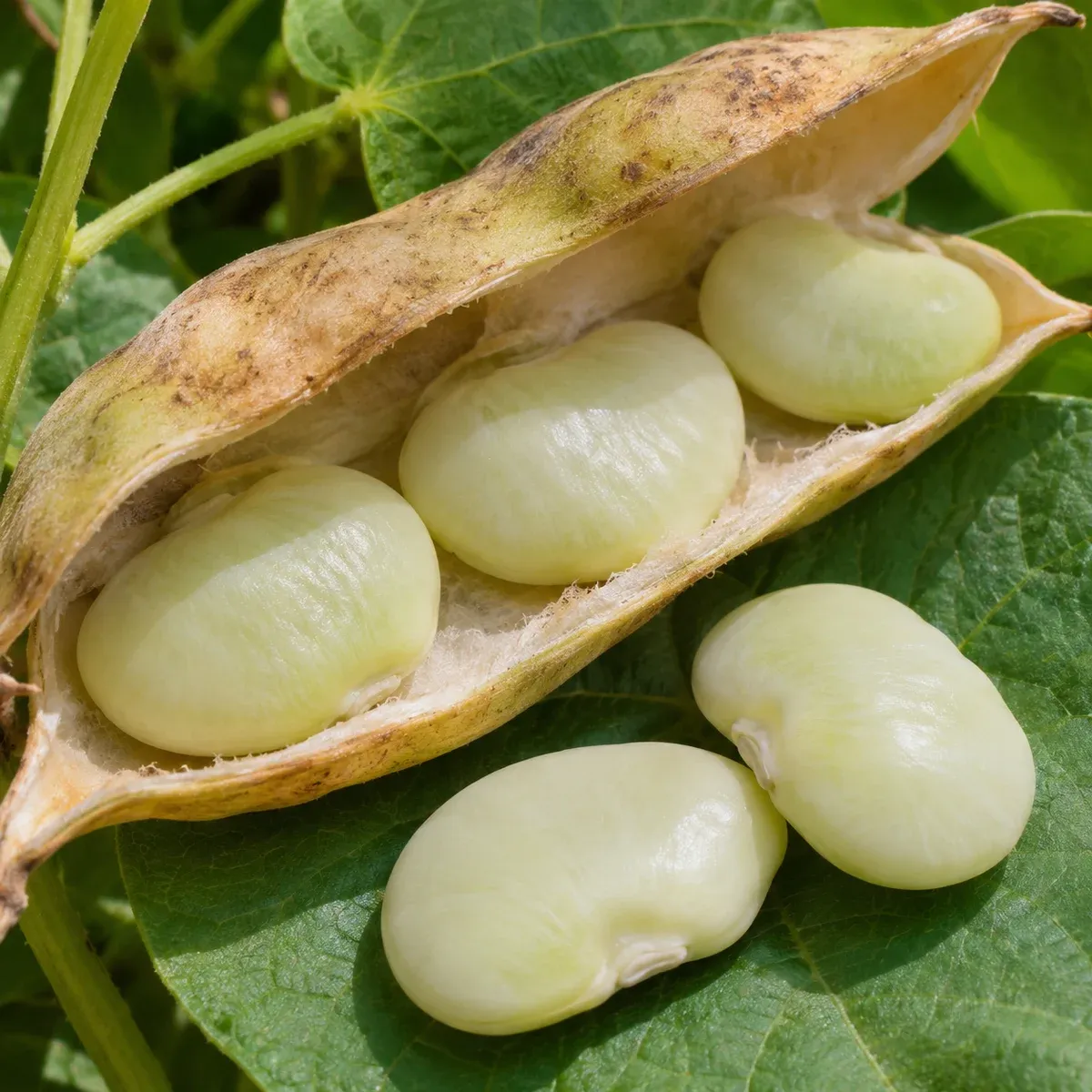
For fresh shelling, look for green pods well filled with developed beans. Maryland For dried beans, wait until the pods are completely dry. Minnesota The fresh shelling stage is different from the very young pod stage at which French beans are harvested.
Saving seeds for the next season
Pick the pods as they turn brown if they are at risk of splitting open or getting wet. Large beans need to dry right through. For seed saving, Seed Savers Connect recommends drying them further in a dry place, spread out or in paper bags, before storing them somewhere cool and dry. Seed Savers Connect Label the variety and year, discard mouldy or damaged beans, and keep seed for sowing separate from beans intended for cooking. Prepare and eat freshly shelled beans promptly; they do not keep like dried beans.
Never consume Lima beans raw
Neither fresh nor dried beans should be eaten raw. The University of Minnesota emphasises this for the species. Minnesota The Centre for Food Safety lists Lima beans among foods that may contain cyanogenic compounds. CFS The BfR also stresses that beans must be cooked thoroughly because of the lectins they contain. BfR
Finding the appropriate preparation for your harvest
For dried Lima beans, consult page 4 of the DGE food fact sheet, under “Wie bereiten Sie getrocknete Hülsen-Früchte zu?”. It specifically distinguishes Lima beans: change the soaking water and do not use this water for cooking. It directs readers to the product instructions for the preparation method and cooking time, which vary with the beans. This section does not provide a universal detoxification time.
For freshly shelled beans from your garden, ask the food supplier or seed merchant for documented preparation instructions for that Lima variety at that harvest stage. The DGE section on dried beans and the CFS studies on cassava or bamboo do not cover this case. Do not substitute the cooking time for French beans.
The drying process described earlier prepares seed for sowing; it does not make the beans ready to eat. Soaking alone and simple reheating do not constitute complete preparation. Label beans intended for sowing and those intended for eating, and keep them separate.
Observing damaged seeds and planning for the following year
Maryland describes feeding punctures made by true bugs, which can let in organisms that cause beans to discolour, shrivel or rot. Maryland Examine the inside of some pods when a problem arises; these signs do not alone indicate a cause. Also note moisture levels and the extent of damage before seeking advice.
Allow good air circulation, handle plants when dry and choose healthy seed. For the next season, plan a different crop family in rotation: simply changing bean types is insufficient. Minnesota, prevention The Lima bean is frost-sensitive and is grown as an annual in cold regions. Seed Savers Connect Reserve your next trial for a warm season.
Key points for this crop
Practical guidance
- Species
- Phaseolus lunatus, harvested for its seeds
- Season
- Sustained warmth and absence of frost
- Growth habit
- Dwarf varieties, or climbing varieties that need support
- Food use
- Never eaten raw; preparation and cooking specific to Lima beans
Sources and references
- Growing beans in home gardensUniversity of Minnesota Extension, Marissa Schuh and Jill MacKenzie, in English Accessed on 18 October 2026.
- Growing Beans in a Home GardenUniversity of Maryland Extension, updated 20 January 2026, in English Accessed on 18 October 2026.
- HO-175: Growing Beans in the Home Vegetable GardenPurdue University Extension, in English Accessed on 18 October 2026.
- Lima BeanSeed Savers Connect, Liz Worth and Nellie Pryke, 15 August 2025, in English Accessed on 18 October 2026.
- Natural Toxins in Food PlantsCentre for Food Safety, Food and Environmental Hygiene Department, Hong Kong, in English Accessed on 18 October 2026.
- Only eat beans when cookedBundesinstitut für Risikobewertung (BfR), in German Accessed on 18 October 2026.
- Managing plant diseases in the home gardenUniversity of Minnesota Extension, Marissa Schuh and Michelle Grabowski, revised 2026, in English Accessed on 18 October 2026.
- Legumes — easy-to-read information, October 2025Deutsche Gesellschaft für Ernährung (DGE), in German Accessed on 8 November 2026.