
The vegetable garden notebook / Crops
Growing Hamburg parsley: sowing, root growth and storage
Hamburg parsley requires space as a root vegetable for several months. Select seeds of this specific type and retain most of the foliage to nourish the root, rather than cutting it as you would for leaf parsley.
Adapt this guidance to your garden’s climate and conditions.
Choosing a root parsley and allocating space
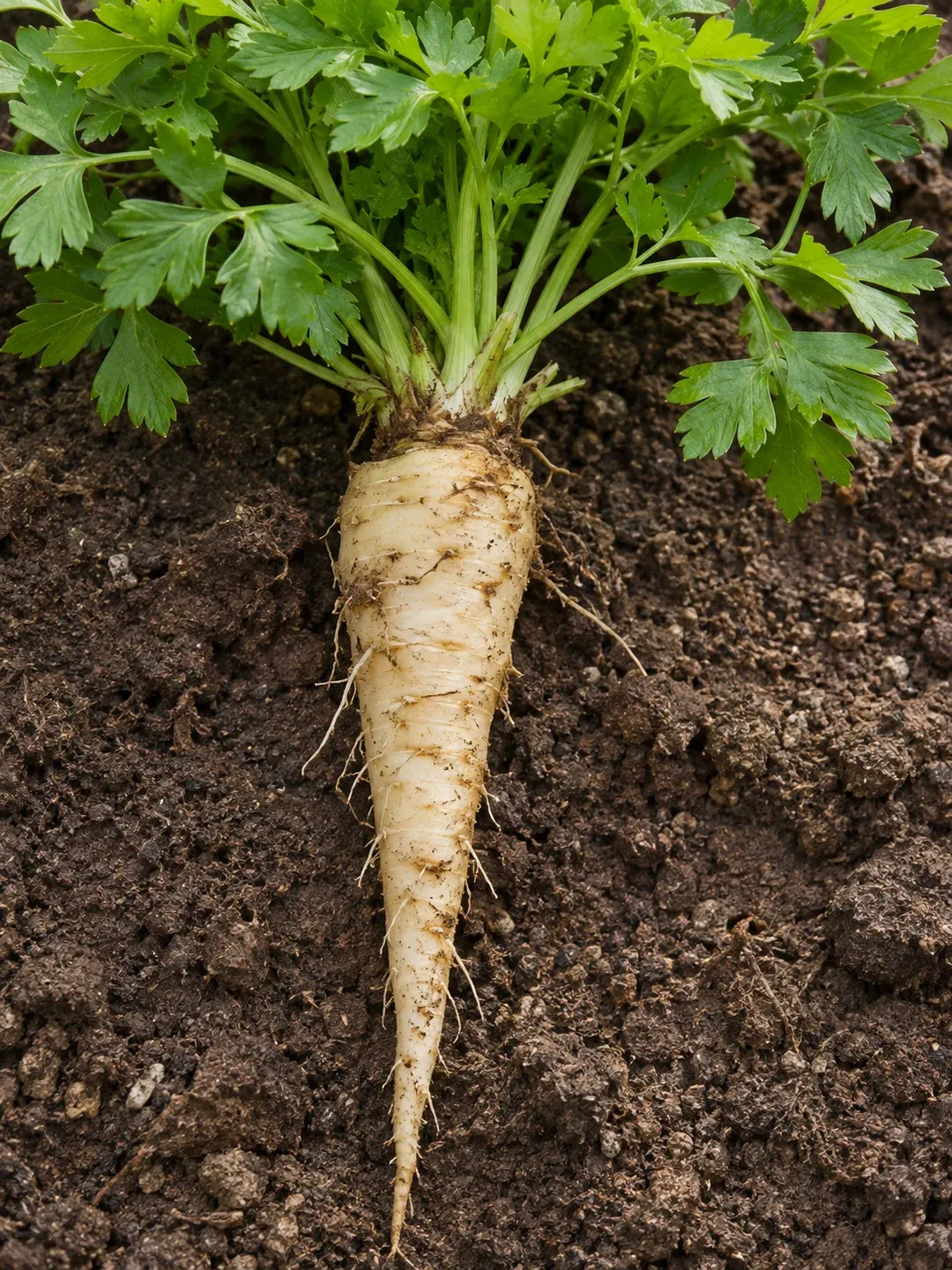
Root parsley, Petroselinum crispum var. tuberosum, is also known as Hamburg parsley. The variety ‘À grosse racine Gros Hâtif’ is listed in the SNHF fact sheet. A packet of ordinary flat-leaf parsley will not meet the same objective.
The root is particularly used in soups and stews; the leaves also serve as a condiment. Cornell describes this third type of parsley separately from flat-leaf and curly varieties.
Expect this crop to stay in the row for a long time. For Gros Hâtif, Sainte Marthe indicates foliage of approximately 40 cm and a root of around 15 cm. In a pot, the latter figure does not refer to container depth: sufficient substrate must also be provided beneath the root. A shallow planter intended for cutting leaves is unsuitable for this purpose; choose open ground or try growing it in a deep container with drainage holes.
Sowing in spring and waiting for seedlings to emerge
Germinance recommends March to May in France, in fertile, deep, light soil with few stones and no fresh organic matter. Choose a sunny or partially shaded spot and wait until excess water has drained from the soil and you can keep it moist.
Their protocol involves sowing at 0.5 cm, in rows spaced 40 cm apart, then thinning to 10–15 cm when seedlings have four leaves. This allows the root to develop directly in its final position. Mark the row and weed carefully while waiting.
Soaking for a day is optional. Germinance sets the optimum germination temperature at 15–20 °C and indicates 20–28 days for seedling emergence; Sainte Marthe suggests 30–45 days. These timelines are not deadlines in cold soil: keep the surface moist without waterlogging and do not resow after just one week. Germinance, Sainte Marthe
Keeping foliage to support root growth
Water at the base, moderately and regularly according to soil dryness. Mulching after establishment helps retain moisture; continue weeding while plants are small. Fertile initial soil is more important than improvised fertiliser applications: the referenced sources do not provide a domestic fertilisation schedule to replicate. Germinance
Harvest only a few leaves at a time. Repeated heavy cutting compromises the aim of growing roots; grow a separate parsley plant for large leaf harvests. Sainte Marthe
Inspect young plants for grazing damage and injured roots. Sainte Marthe notes carrot fly, whose larvae burrow tunnels, as well as wood mice. Yellowing foliage alone does not identify either: also check soil moisture and root condition before any intervention. Sainte Marthe
Harvesting in autumn, storage, and understanding the second year
Sainte Marthe estimates around six months from sowing to harvest for Gros Hâtif. Lift one root first to assess its development: this timeline does not replace observation. Harvest thereafter as needed. Sainte Marthe
Storing roots in a sand-filled crate
For a small batch, use a method that allows inspection: Germinance mentions storage in sand after removing leaves and rootlets; the RHS details preparation and storage conditions for root vegetables.
- Sort at harvest and reserve undamaged roots for storage. Separate injured roots; do not store rotten or suspect roots with the others.
- Cut the foliage and rootlets as per Germinance, then shake off loose soil. Avoid damaging the root during preparation.
- Arrange roots in layers in a crate with moist sand, following the RHS root storage principle. The aim is to limit wilting, not to keep the batch submerged.
- Place the crate in a dark, frost-free location, such as a suitable cellar. Ensure it remains accessible for monitoring and removing deteriorating roots. A label reading ‘cellar’ is insufficient if the space freezes or remains waterlogged.
A clamp is another option mentioned by the seed supplier; its construction cannot be inferred from a simple crate. If roots remain in the garden, watch for wood mice and ensure access before frost prevents lifting.
Parsley is biennial: plants kept over winter may produce a flowering stem with umbels in the second year. This phase serves reproduction; for culinary roots, plan a new crop rather than relying indefinitely on the same plant. SNHF
Key points for this crop
Practical guidance
- Identity
- Petroselinum crispum var. tuberosum, Hamburg parsley
- Objective
- Fleshy root harvested in the first year
- Sowing
- Direct sowing in spring; seedlings take several weeks to emerge
- Cycle
- Biennial; flowering typically in the second year
Sources and references
- ParsleyFrench National Horticultural Society Accessed on 18 October 2026.
- Early large-rooted Hamburg parsleyGerminance, seed producer and distributor Accessed on 18 October 2026.
- Organic Gros Hâtif large-rooted Hamburg parsleyLa Ferme de Sainte Marthe, seed supplier Accessed on 18 October 2026.
- Root Concerns, July 2020 — More Than Just A Pretty Garnish, page 6Cornell Cooperative Extension, Rensselaer County Master Gardeners, in English Accessed on 18 October 2026.
- Root vegetables: storingRoyal Horticultural Society, in English Accessed on 8 November 2026.