
The vegetable garden notebook / Crops
Sowing broad beans: autumn or spring for your garden
Before opening a packet of broad beans, ask whether they can overwinter outdoors in your garden. Consider the variety, climate and soil condition together when choosing the sowing season.
Adapt this guidance to your garden’s climate and conditions.
When should you sow broad beans?
The SNHF recommends autumn, starting in October, in the warm regions of the Midi and South-West of France; elsewhere, it suggests February-March as an early-spring guide. These dates help guide your choice, not impose sowing in frozen or waterlogged soil.
For autumn sowing, meet three conditions: a locally mild winter, a well-drained location, and a variety suited to overwintering. The RHS distinguishes varieties adapted for autumn from those intended for spring. Read the seed packet before purchase.
A very damp or exposed site is a reason to postpone sowing: the RHS highlights these limitations of autumn sowing. A result from a particularly sheltered corner may not apply even to a neighbouring garden. The November calendar puts this choice alongside other seasonal jobs.
Preparing a row and sowing
Choose a sunny, sheltered spot with no standing water. Remove existing weeds. Broad beans thrive in deep soil that retains moisture without becoming waterlogged. SNHF · RHS
For sowing in single rows:
- Check sowing depth and spacing on the seed packet. If unavailable, the guidelines below provide a starting point.
- Mark rows approximately 45 cm apart, as per the RHS growing guide.
- Place one seed every 20 cm, about 5 cm deep, following the RHS practical sheet, then cover.
- Keep the soil slightly moist until seedlings emerge, without soaking the row. SNHF
- Label the variety and sowing date. Count the seeds sown to monitor gaps later.
Depth recommendations vary: the SNHF suggests about 2 cm, while the RHS recommends more. Prioritise the instructions specific to your seeds; the 5 cm above is not a mandatory depth for all situations. For the general steps, see the sowing guide.
Supporting growth
Weed between rows, especially early on. The SNHF advises drawing soil around the base when plants reach about 20 cm. To support stems, install stakes and twine around the row, particularly for tall varieties. RHS, cultivation practices
Monitor moisture closely during flowering. In open ground, adjust watering based on rainfall and soil type: the RHS does not recommend constant watering, except for light soils with specific needs. Its practical sheet emphasises watering at the start of flowering. Check the soil before adding water.
Many flowers but few pods: what should you check?
First, compare the bottom and top of the plants, then track progress: the RHS notes that lower pods mature first. Next, check moisture levels during flowering, especially in pots. The SNHF also warns that high temperatures can halt growth before pod formation.
Ferme de Sainte Marthe describes broad beans as mainly self-fertilising, with cross-fertilisation by insects also possible. Observe insect visits and flower access under protection, while also assessing water, heat, and plant health. A few flowers without pods do not indicate a single cause for failure. Record conditions and photograph unusual deterioration to request identification.
Observe aphids before deciding on treatment
Inspect young shoots and the undersides of leaves. Aphids may cluster there; their black colour alone does not identify the species. The RHS aphid sheet advises tolerating their presence where possible, while monitoring colony and plant development.
Before intervening, observe other insects present: ladybirds and hoverflies are among the natural enemies of aphids. If you choose to reduce an identified aphid colony, targeted manual removal is an option suggested by the RHS. Photograph unusual symptoms and seek identification before selecting a treatment.
Recognising when to harvest
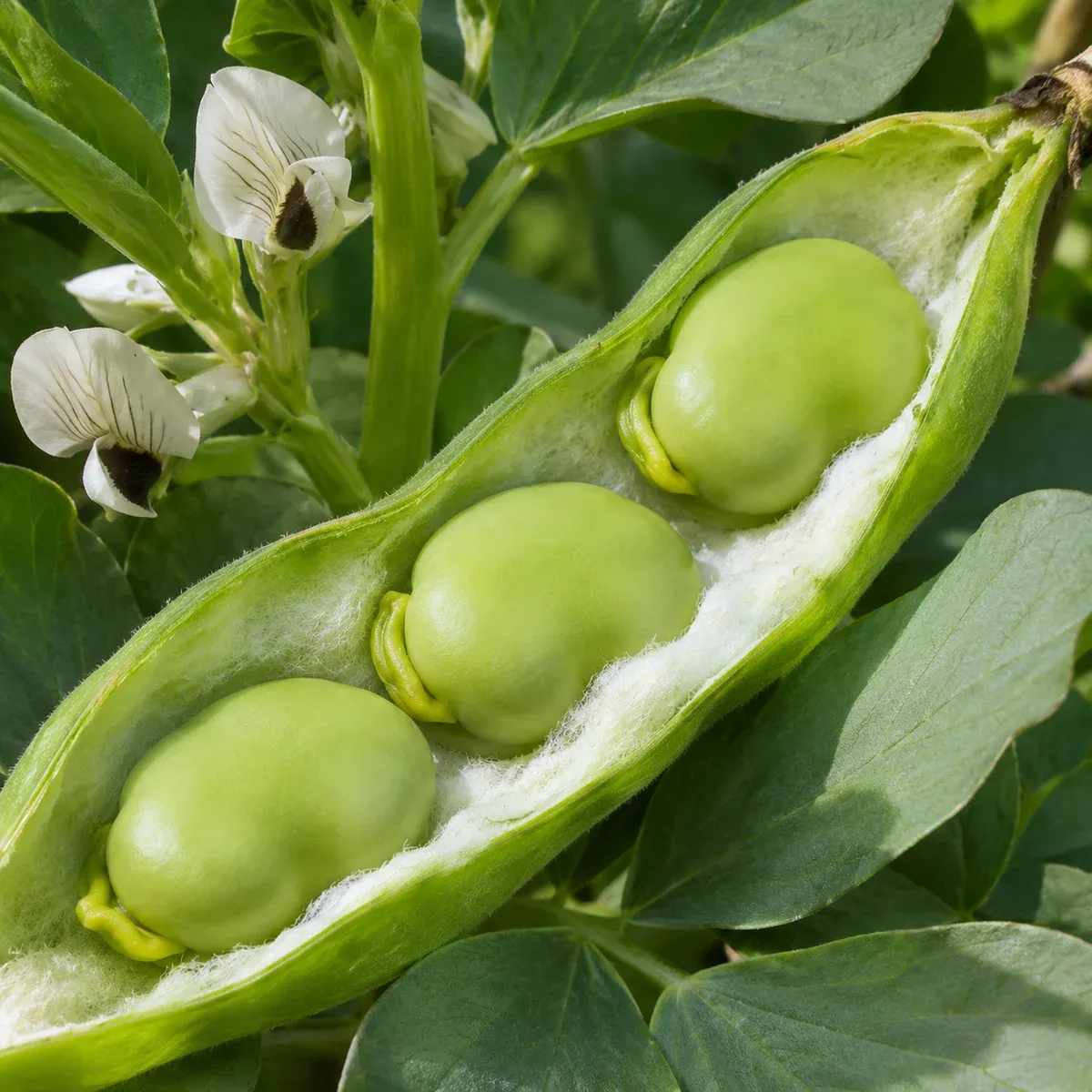
For a fresh harvest, look for green pods with beans already formed inside: this is the benchmark from the SNHF. Start by checking the lower pods, which mature first. Cut them with scissors or secateurs rather than pulling the stem. Return regularly during harvest. RHS
Note the first and last harvest dates, along with the variety and sowing date. This provides your own local benchmarks for the following season.
Can seeds intended for autumn be kept until spring?
The RHS confirms this for ‘Aquadulce’: this broad bean does not require winter cold to flower. However, verify the indicated period for your variety. Missing autumn does not justify sowing in poor conditions.
Which broad bean and container should you choose for pot growing?
Select a dwarf variety: the RHS recommends ‘The Sutton’ for containers. Use a pot at least 40 cm wide, filled with multipurpose or loam-based potting compost, and space plants about 15 cm apart. This width does not specify volume in litres.
Place the pot in full sun, in a sheltered spot, and monitor moisture more frequently than in open ground. From the first flowers, the RHS recommends potassium-rich feed for containers; follow the product instructions and take account of the potting compost used. This approach requires monitoring until harvest.
Key points for this crop
Practical guidance
- Exposure
- In full sun, sheltered from strong winds
- Soil
- Moisture-retentive, deep, and well-drained
- Autumn sowing
- In mild climates, with a suitable variety
- Fresh harvest
- Green pods with beans already formed inside
Sources and references
- Broad beanFrench National Horticultural Society (SNHF) Accessed on 15 October 2026.
- How to grow broad beansRoyal Horticultural Society (RHS), in English Accessed on 15 October 2026.
- Sowing broad beans in autumn or springRoyal Horticultural Society (RHS), in English Accessed on 15 October 2026.
- Grow broad beans with childrenRoyal Horticultural Society (RHS), in English Accessed on 15 October 2026.
- Blackfly (Black Bean Aphid)Royal Horticultural Society (RHS), in English Accessed on 15 October 2026.
- Growing broad beans successfullyLa Ferme de Sainte Marthe, seed supplier guide Accessed on 18 October 2026.