
The vegetable garden notebook / Crops
Growing asparagus: planting crowns and managing harvests
Asparagus needs a permanent spot and patience at first. Its young shoots, called spears, are harvested in spring; afterwards, the foliage must develop to prepare for the following year’s production.
Adapt this guidance to your garden’s climate and conditions.
Choosing the type and understanding the crown
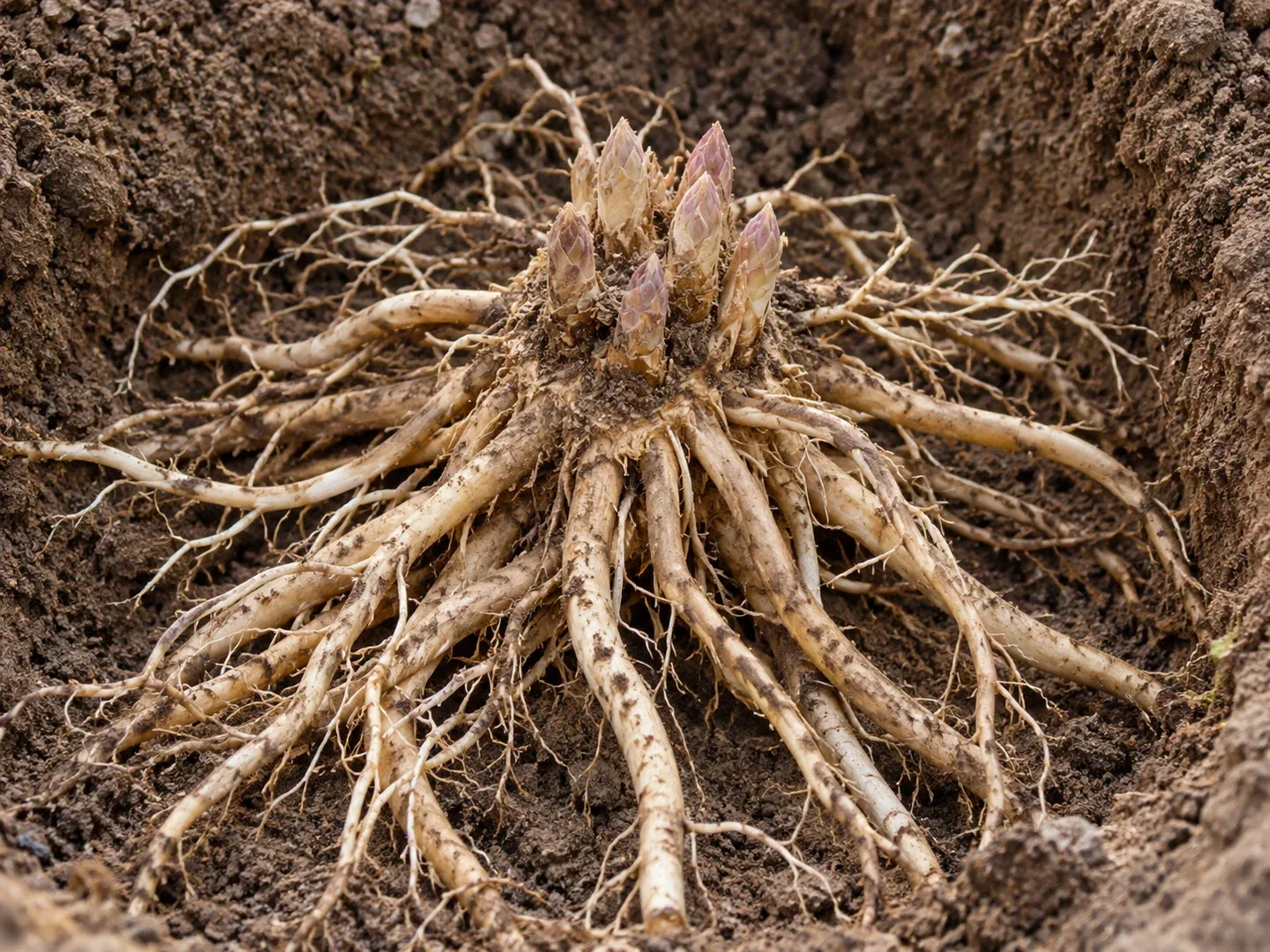
The crown is the underground structure bearing roots and buds. Buying one-year-old crowns allows for a quicker start than sowing seeds. Sowing is possible but extends the waiting period and requires a well-maintained nursery bed. The RHS distinguishes between these two starting methods.
Select a variety suited to your intended use: green, white, or purple. The SNHF lists, for example, ‘Argenteuil hâtive’ for white, ‘Burgundine’ for purple, and varieties that can be grown for either white or green asparagus. White asparagus is obtained by keeping spears shielded from light through earthing up; green asparagus develops in the open. Therefore, verify both the variety and the cultivation method.
All-male varieties limit seed production. On female plants, flowers may produce inedible red berries, as noted by Minnesota Extension. The part used in cooking remains the young shoot before it develops into a branched stem.
Reserve the bed before purchasing
Choose a sunny, sheltered, and permanent location with deep soil that drains well. Weed thoroughly, especially competing perennials. An asparagus bed can remain in place for many years: it sits outside annual crop rotation. Avoid replanting new asparagus in an old asparagus bed, as advised by the RHS.
Prepare the bed with well-decomposed organic matter; a soil analysis helps you adjust what you add before establishing this long-term bed. Good drainage matters more than having sandy soil. In heavy soil that remains waterlogged, a raised bed may be preferable; adding a little sand is not sufficient to resolve all situations.
Planting crowns in spring
In France, plan to plant in spring when the soil is drained and workable, adjusting the date to your region and the condition of the crowns. Avoid letting the roots dry out while waiting. The SNHF provides this planting guideline: 50 cm between crowns, in trenches spaced 1.20 to 1.50 m apart and approximately 25 cm deep.
Place the buds facing upwards, handle the roots carefully to avoid breaking them, and cover lightly. Water to ensure soil contact with the roots, then gradually fill in as the shoots develop. The preparation depth does not mean the crown should be immediately buried under 25 cm of soil. Keep access clear for earthing up if you choose to grow white asparagus.
For sowing, follow the variety’s instructions and first raise the young plants without competition before their final planting. Allow approximately one additional year before harvest, as advised by the RHS.
Watering and protecting reserves
Pay close attention to soil moisture in the first season. After that, water during prolonged drought and check the soil: foliage may lack water without showing clear wilting, as warned by Minnesota Extension. The stems also rebuild the plant’s reserves after harvesting ends.
Hand-weed near the plants to avoid damaging the spears and roots. Maintain soil cover with mature garden compost or a suitable mulch, without repeatedly feeding before checking what is needed. If plants grow poorly, check the soil, moisture, and history before assuming that a lack of fertiliser is the cause.
In summer, stakes and string can support tall stems against the wind. Do not cut them while they are still green. Wait until the foliage turns yellow in autumn before cutting it back at the base, as advised by the RHS.
Start small, then know when to stop
For one-year-old crowns, count from their planting in the garden, not from when they first began growing. Here is the guideline from the SNHF, with N as the planting year:
- N and N + 1: let the stems develop without harvesting any to eat; these are the two establishment seasons.
- N + 2: first limited harvest of approximately 15 days, only if plants are vigorous.
- N + 3: guideline of 20 to 25 days of cutting.
- From N + 4 onwards: guideline of 40 to 45 days of cutting for mature plants.
For example, if you plant crowns in spring 2027, you should only consider a first short harvest in spring 2029. Treat these durations as upper limits to reassess, rather than targets for weak plants; wait longer if establishment has been poor.
The season begins in spring, often in April or May depending on the region. For green asparagus, harvest the tender spears before the tips open, by the time they reach about 18 cm tall, as noted by the RHS. Use a clean knife without damaging neighbouring shoots. For white asparagus, monitor the mound and harvest spears before prolonged exposure to light. Harvesting underground requires locating the shoot rather than cutting randomly into the crown.
At the end of the chosen period, stop cutting and allow all new stems to grow. Minnesota Extension lists a marked slowdown in growth or spears thinner than a pencil as reasons to stop harvesting; do not keep cutting simply to reach the maximum duration.
Use the spears promptly. Minnesota Extension gives a storage life of up to one week in the fridge, but that depends on their condition at harvest; there is no reason to wait that long before eating them. Freezing is another option.
Pots, winter, and problems to watch for
The compromise of container growing
Growing in a large pot is possible, but the RHS warns that the crop yields less and has a shorter productive life than in open ground. It recommends a minimum of 30 cm in width and depth, with one crown per container. Ensure adequate water, a well-draining potting compost, appropriate fertiliser applications, and support. This compromise does not replace a permanent asparagus bed for large harvests.
Winter and monitoring young shoots
The rootstock persists through winter; spears that have already emerged can be damaged by late frost. Protect young shoots when frost is forecast and avoid areas where cold air accumulates. A rootstock that survives winter and a spring shoot do not have the same sensitivity.
Checking signs of problems
Curved spears, yellowed stems, or poor regrowth can have several possible causes. Examine the soil, bite marks, insects, and spots: asparagus beetles, slugs, rust, and rot are among the problems cited by the RHS and Minnesota Extension. Frost can also bend shoots. Take photographs before acting; once the problem has been identified, remove clearly diseased foliage separately from healthy plant remains.
Propagating without disrupting the productive bed
Dividing a well-established crown is possible but disrupts its growth: the RHS recommends doing this only when you need to propagate plants, with several years between divisions. To expand the crop without disturbing the whole productive bed, use new, healthy crowns in a prepared site.
Key points for this crop
Practical guidance
- Location
- Permanent, sunny, and well-drained bed
- Typical start
- One-year-old crowns to plant in spring
- First harvest
- After two growing seasons, if plants are vigorous
- After harvest
- Let stems grow until they turn yellow in autumn
Sources and references
- AsparagusFrench National Horticultural Society (SNHF) Accessed on 18 October 2026.
- How to grow asparagusRoyal Horticultural Society (RHS), in English Accessed on 18 October 2026.
- Growing asparagus in home gardensUniversity of Minnesota Extension, in English Accessed on 18 October 2026.
- Harvesting asparagusUniversity of Minnesota Extension, in English Accessed on 18 October 2026.