
The vegetable garden notebook / Getting started
Basic Equipment for the Vegetable Garden: Choose According to Your Tasks
Start with the next task at hand: planting, sowing, weeding, or watering. Take stock of the equipment you have, then only add what is missing for your project.
Adapt this guidance to your garden’s climate and conditions.
- Define
List the tasks planned for your first sowing or planting.
- Check
Inspect the condition, grip, and use of any equipment you already have.
- Reuse
Keep tools and containers that are suitable, clean, and in good condition.
- Maintain
Clean and dry tools before storing them in a sheltered place.
- Expand
Add equipment only when a specific task justifies it.
Start with the Tasks at Hand
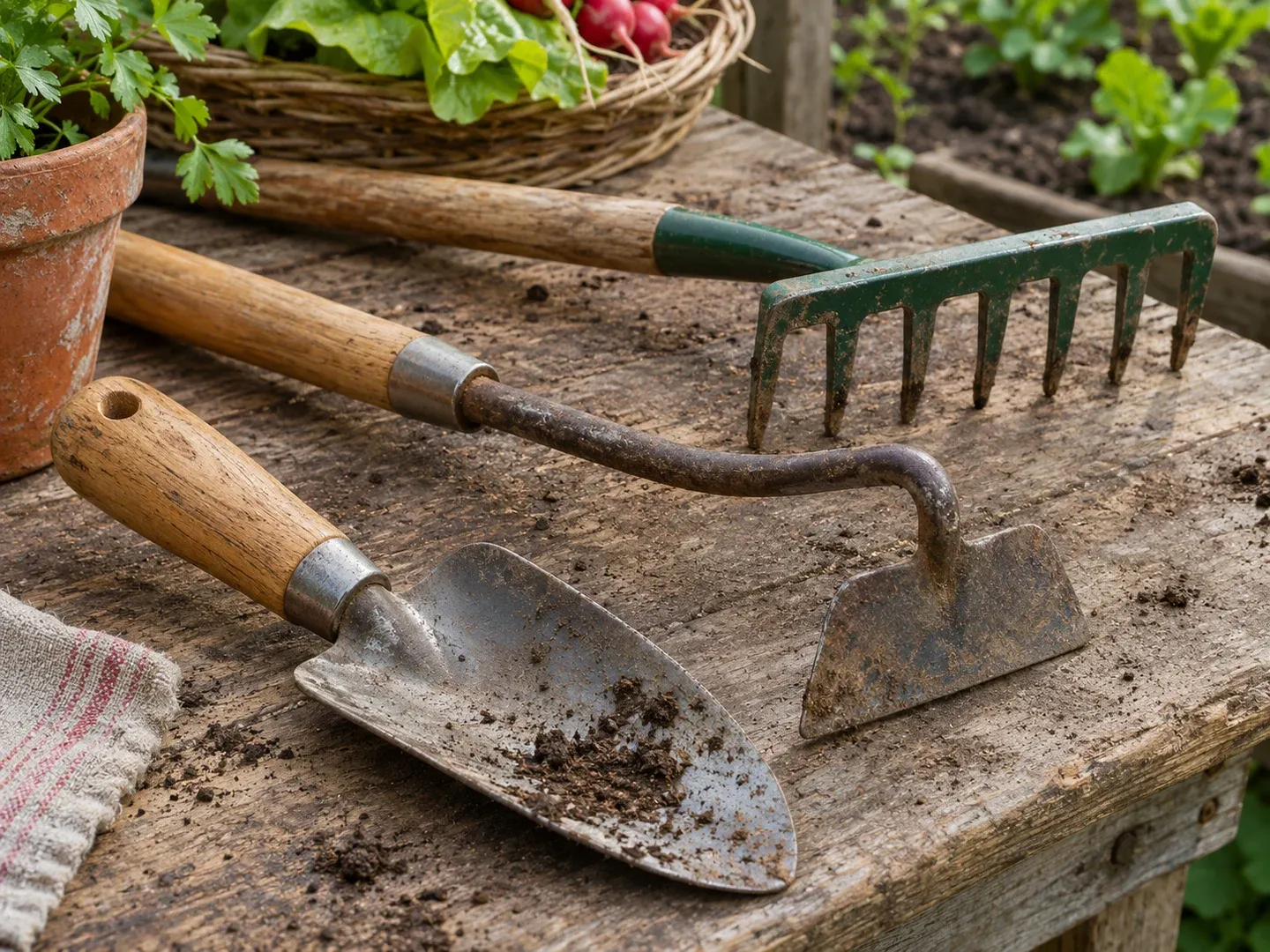
Planting up a planter and preparing a bed do not require the same equipment. Note your next task, then see what you already own or can borrow. The University of Illinois advises sticking to basic tools when starting out: a collection of accessories is not necessary for gardening.
If the location and crops are yet to be chosen, first create your vegetable garden plan. You can then choose equipment to suit this plan.
Example: Planting Two Pot-Grown Seedlings in a Container
First, check the growing instructions to ensure the container can accommodate both plants at their mature spacing. Gather the available perforated container, the appropriate growing medium, a trowel, plant identifiers, and a watering can whose weight and flow rate you can manage. The Maryland guide notes that volume and drainage matter when reusing containers; Illinois describes the trowel for planting holes. A garden rake or spade is not necessary for this single task.
Example: Sowing a Small Row in the Ground
If the bed is already prepared, plan for a rake to level the surface, string and a metre rule for the row, labels, and a watering can suitable for sowing. Borrowing the rake for this task may suffice; a hoe can be added if young weeds genuinely need removing. These functions follow Illinois. The seed packet and sowing method determine spacing and depth; the tool list does not set these.
After each session, plan for the cleaning and storage described below. These examples provide a basic set for a specific task, not a kit to purchase.
Match Each Tool to a Task
| Task | Useful equipment |
|---|---|
| Digging a hole for a plant | A trowel, a small hand-held garden shovel. |
| Preparing the surface of a row for sowing | A rake to break up clods and prepare the seedbed. |
| Weeding between rows | A hoe for removing young weeds. |
| Marking crops and their spacing | A ruler or metre rule, string, and labels with the name and date. |
| Watering seeds and new plants | A watering can; the flow rate must suit the plant’s stage. |
These uses are described by the University of Illinois. Focus on the rows that apply to your garden, without turning this table into a mandatory shopping list.
For young weeds, hoe shallowly: digging too deeply can damage vegetable roots, notes the University of Minnesota. Do not routinely push a hoe deeply into the soil around plants.
For sowing in pots or trays, a fine rose attachment allows gentle watering that avoids displacing seeds. This precaution from Minnesota complements our sowing guide. The choice of equipment does not determine frequency: consult the watering guide to observe actual needs.
Check the Grip Before Expanding
Hold the tool and mimic the intended task. The handle, weight, and grip should suit you, including with the gloves you will wear. Ensure no parts are loose and that a reused handle is not split. For a watering can, test the journey to the crops with an amount of water you can comfortably carry.
These are practical selection criteria, not an ideal size or weight for everyone. Trying a borrowed tool can help clarify what you need before equipping yourself.
Reuse Suitable Containers
Keep your pots and seed trays that are still usable. The RHS recommends extending the life of existing plastic equipment until the end of its useful life.
A reused container must, however, be suitable for the crop. Check its volume, depth, and drainage. To repurpose a household container, choose one safe for food contact and whose previous use you know; avoid those that have contained paint, detergent, glue, or other chemicals, as well as degraded plastics. These limits come from the Maryland guide.
Clean reused pots inside and out. Soil and debris can carry disease agents, even on an apparently clean container, explains the University of Minnesota.
Plan Maintenance from the Start
Keep a brush and an old cloth near your storage area. After use, remove soil from tools; wash very muddy parts, then dry them. Check fixings and maintain joints according to the instructions before storing in a dry place. The RHS emphasises drying to limit rust and swelling of wooden handles.
Cleaning and disinfecting are two different operations. After working on a diseased plant, or before bringing a tool used elsewhere into the garden, Minnesota recommends cleaning then disinfecting. First remove debris and follow the label of a product suitable for the use and material, particularly its contact time. Do not mix products.
Add Equipment Based on Identified Needs
After your first sessions, note the task for which you actually lacked equipment. Do you need to prepare more surface, transport material, or make a cut specified in the growing instructions? Then choose the corresponding tool and plan its storage space.
For a one-off need, first consider borrowing. For regular use, prioritise a tool you know how to handle and maintain. Your equipment can thus evolve with the vegetable garden, without a set minimum budget or mandatory kit.
Sources and references
- Get Your ToolsUniversity of Illinois Extension, in English Accessed on 16 October 2026.
- Planting the vegetable gardenUniversity of Minnesota Extension, in English Accessed on 16 October 2026.
- Controlling weeds in home gardensUniversity of Minnesota Extension, Jill MacKenzie, in English Accessed on 16 October 2026.
- How to garden without plasticRoyal Horticultural Society (RHS), in English Accessed on 16 October 2026.
- Growing Vegetables in Containers and Salad TablesUniversity of Maryland Extension, in English Accessed on 16 October 2026.
- Cleaning hand toolsRoyal Horticultural Society (RHS), in English Accessed on 16 October 2026.
- Clean and disinfect gardening tools and containersUniversity of Minnesota Extension, in English Accessed on 16 October 2026.